Bouquet "Firebird"
Price incl. VAT 0%
✓ In stock
2 unit(s) available
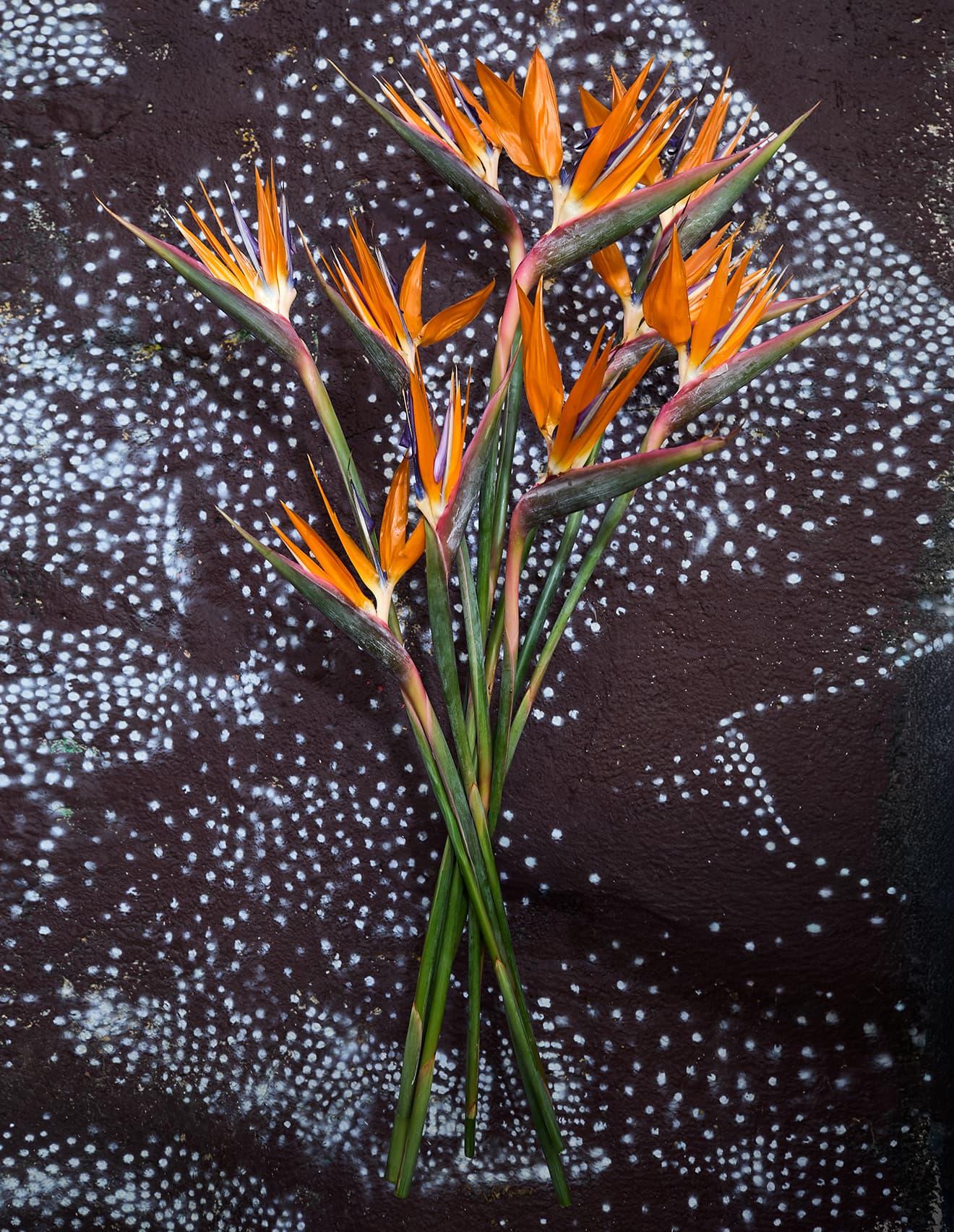
Orange and blue, each head turned sideways like a bird in profile. The name comes from the ballet Anna Pavlova refused in Paris in 1910 — she couldn't make sense of Stravinsky's music.
Flowers in this bouquet
Description
A bird of paradise bouquet, and only that: no foliage, no second flower. What looks like a beak is a hard green sheath set crosswise on the stem, and it holds a queue of flowers rather than a single one. On the plant they emerge in turn, unaided. As cut flowers, strelitzias often can't manage it; the blooms stay jammed inside. So I ease each one out by hand before the bouquet leaves, slowly enough not to snap it, and it arrives already open.
It comes from the east coast of South Africa, also goes by the name crane flower, and is pollinated by birds — through their feet. A bird lands on the blue petals to reach the nectar; its weight splits them open and dusts its feet with pollen, which it carries to the next flower. Very few plants are pollinated through a bird's feet.
The name is a piece of court politics. The plant reached Kew in 1773, and Joseph Banks named it after Queen Charlotte, born a princess of Mecklenburg-Strelitz — hence strelitzia. The compliment helped keep royal patronage on Kew's side.
On 25 June 1910, Diaghilev's Ballets Russes premiered The Firebird at the Paris Opéra. The title role was first offered to Anna Pavlova, who found Stravinsky's score incomprehensible and turned it down. Tamara Karsavina took it, and the success was immediate. So this one is for whoever accepted the part someone else refused, and made it theirs.
Not a holiday-exotic centrepiece. It wants floor space rather than table space: a tall vase on the floor by a window, or a bare corner that has been waiting for something worth the room.
About the height: the stems come in at around 70 cm. If you want all of it, add a note to your order; without one, I'll cut them down for a standard medium vase. Whichever you choose, the heads are heavy, and only a tall vase with a wide, weighty base keeps them upright. Every two days, take a little off the stems and refresh the water; keep the bouquet out of direct sun. Expect a week at the very least, and two if you keep this up.