
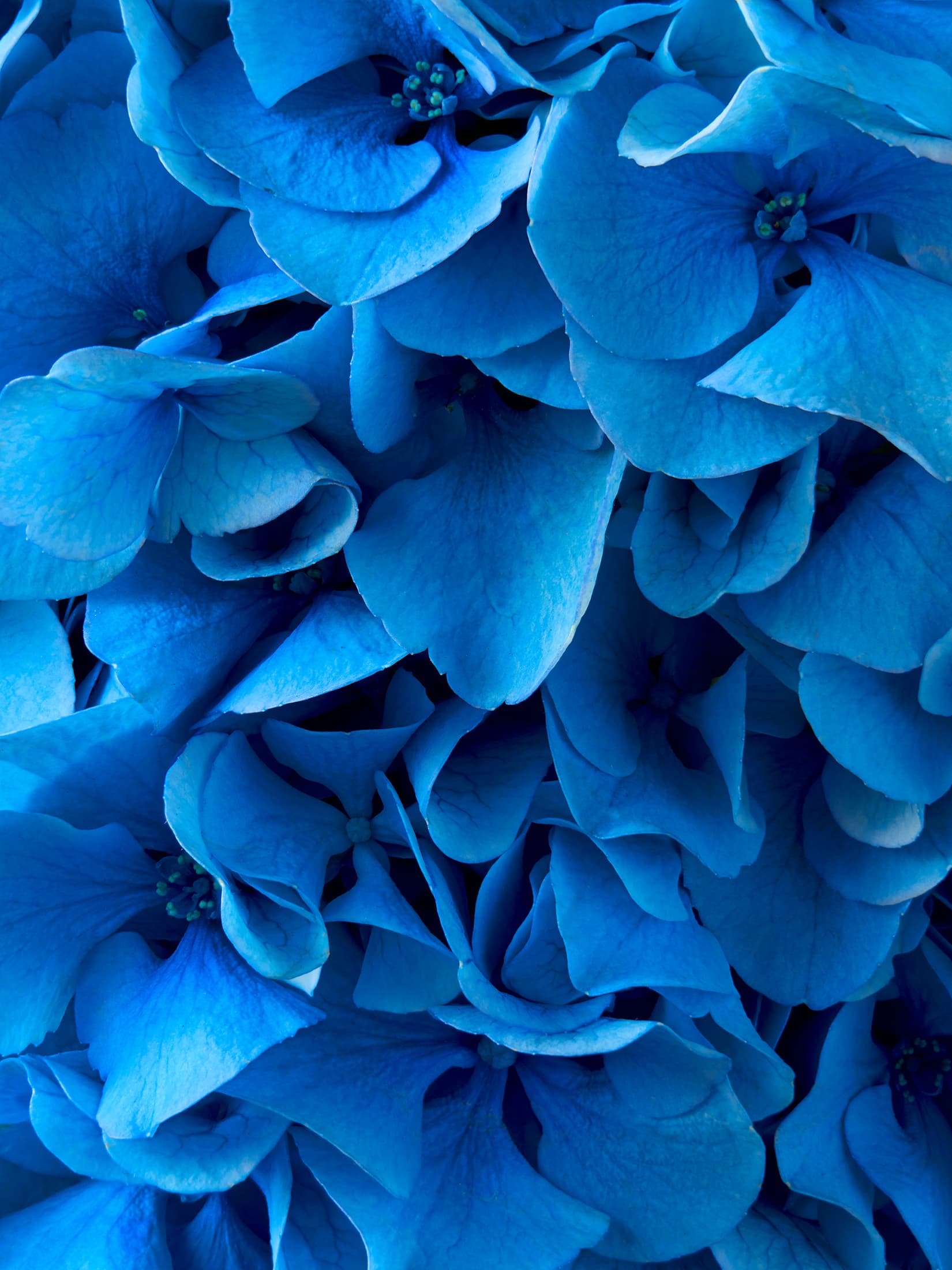
And it is the largest lie in contemporary floristry. The real hydrangea is a flower whose colour depends directly on the soil its bush grew in. A flower that holds a season from April through November, moving through every register — translucent blue to burgundy, soft pink to deep green-purple antique.
What follows is why it is worth no longer seeing the hydrangea as wedding pastel, and starting to see what it actually is: a plant whose colour is at once the trace of soil, the chemistry of pigment, and the stage at which it was cut.
The hydrangea is Japanese
Genus Hydrangea, family Hydrangeaceae. The name is Greek: hydor — water, angeion — vessel. Literally, a vessel of water. Officially the reference is to the cup-shaped seed capsule, noted by the Dutch botanist Gronovius in 1739 (Linnaeus formalised the name in Species Plantarum in 1753). Unofficially it is also about the plant's thirst. Both are true.
Origin: Hydrangea macrophylla, the cultivar that dominates the cut-flower market, comes from the coastal mountain regions of Honshu and Shikoku in Japan. The climate there suits it exactly: warm humid summers, mild winters, volcanic acidic soils (which give the blues without any intervention), and the June rainy season — tsuyu — which coincides with the bloom. A plant that evolved for that season. In Japanese culture the hydrangea is ajisai, the flower of rainy June, a symbol of long flowering through drizzle.
It arrives in Europe late, end of the eighteenth century, via the English botanist Joseph Banks who brought it to Kew Gardens in 1789. Which explains its absence in medieval European painting, unlike roses and lilies.
Three species are used in cut floristry: Hydrangea macrophylla (the classical Japanese mophead — all the Premium, Royal, Rodeo, Verena, Aubergine cultivars), Hydrangea paniculata (panicle-shaped, Japanese and Chinese — Magical Candle, Limelight), and Hydrangea arborescens (American tree-form — Annabelle).
A detail that changes how you see the flower: what looks like petals aren't. They are sepals — calyx leaves. The real flowers of the hydrangea are tiny, hidden in the centre or fully sterile. The big head is an oversized decorative calyx. The sepal nature is why hydrangea lasts so long, and why it dries so well.
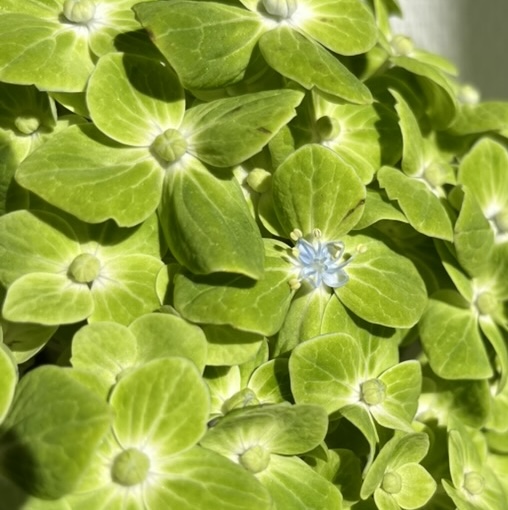
The chemistry of colour, or why one cultivar can be blue or pink
The strangest fact: the same cultivar can flower blue in one garden and pink in the next. It is not a whim, it is soil chemistry.
In the sepals of macrophylla there is a pigment — the anthocyanin delphinidin-3-glucoside. In acidic soil (pH below 5.5), aluminium becomes bioavailable: soluble, absorbable by the plant. The aluminium rises through the roots, reaches the sepals, and forms a blue metal-organic complex with the anthocyanin. The bush turns blue.
In alkaline soil (pH above 6.5), aluminium stays bound to soil minerals. The plant does not get it. Anthocyanin without aluminium shows its native colour — red-pink. The bush turns pink.
In neutral soil (around pH 6) — a mix. The complex lavenders, violets and dusty wines come from there. Many Paris florists work in exactly that zone.
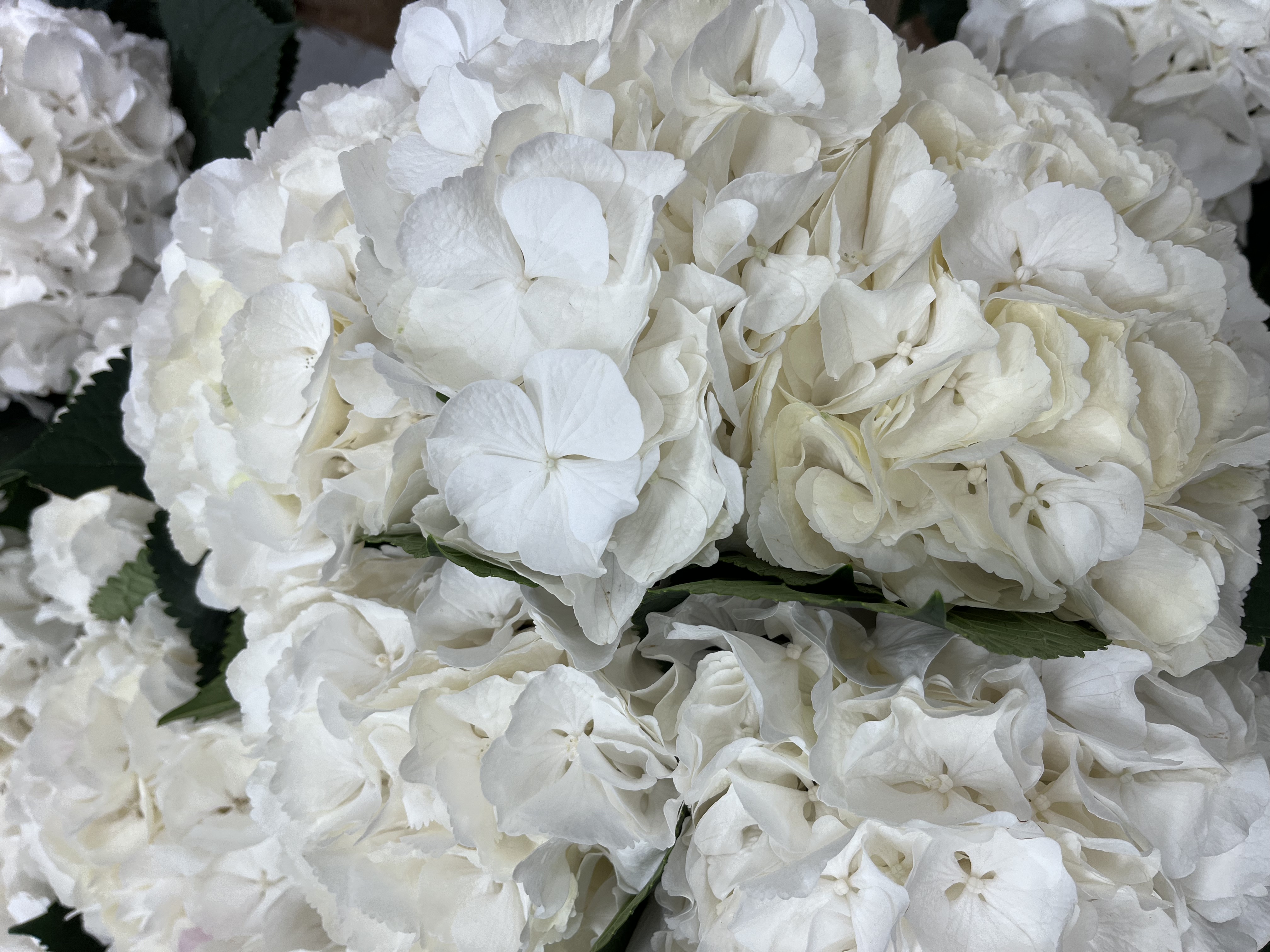
White cultivars contain no anthocyanin at all. Schneeball, Annabelle, Madame Émile Mouillère, Premium Blanc — they stay white regardless of soil chemistry. It is the nature of the pigment, not a breeder's design choice.
In practice: the colour of a hydrangea is not a design decision. It is a biography. A bush in acidic aluminium-rich soil gives blue. The same cultivar in neutral soil gives pink. Cut late in the season — antique. What you hold is not a catalogue palette but the history of one plant.
If you have a bush in the garden — how to change or deepen the colour
That biography is partly editable if the bush is your own. The rules are simple but slow — changes take weeks, sometimes a full season.
For blue, or to deepen blue. Lower the soil pH and make aluminium bioavailable.
— Aluminium sulphate, the most direct method. Available in garden centres. Apply two or three times per growing season, around 200–250 g per bush, dissolved in 10 litres of water, poured at the base. Not on dry soil, not on leaves.
— Iron sulphate acidifies without adding aluminium. Useful as a supporting amendment.
— Natural acidifiers as mulch: pine needles, oak leaves, used coffee grounds, peat. A 5–7 cm layer around the bush in spring. Slower than sulphate, but without chemical spikes.
For pink, or to deepen pink. Raise the soil pH and bind the aluminium.
— Garden lime or dolomite. About 150–200 g per bush, twice a season, in early spring and midsummer. Mix gently with the topsoil.
— Wood ash, alkaline in itself and a source of potassium. A cup per bush in spring.
— Phosphorus-rich fertilisers bind aluminium in the soil. They shift the colour towards pink indirectly.
The Breton tradition — burying terracotta tiles. In western France, particularly in Brittany where the hydrangea is part of local identity and the deep blue domes by the coast are famous, broken terracotta roof tiles or ceramic shards are traditionally buried under the bush. The logic is honest: terracotta is an aluminium-silicate clay, rich in aluminium compounds. In Brittany's acidic soil the tile slowly breaks down and gradually releases aluminium, which the bush takes up for its blue pigment. No spikes as with industrial sulphate, no risk of overdose. A technique with generations of practice behind it, working on the same chemistry as modern aluminium fertilisers — only slowly and patiently.
For violet or a complex lavender-burgundy. Keep the pH around 6.0, between strong blue and strong pink. The hardest colours, and they appear naturally in bushes growing in chemically uneven ground.
To remember: changes take time, at least one season. White cultivars do not change — no anthocyanin. Sudden pH swings stress the plant; a one-year plan beats a shock therapy.
The hydrangeas I work with
The hydrangea season is long — April through November, seven months. The longest floral season of my year.
May to July — the soft Premium cultivars. Premium Blanc, Premium Bleu, Premium Blush, Premium Rose, Premium Vert. Schneeball, the German "snowball," the cleanest of whites. These arrive young, with thin cool sepals, clear uniform colour. The audience here is wedding and minimal-pastel interiors.
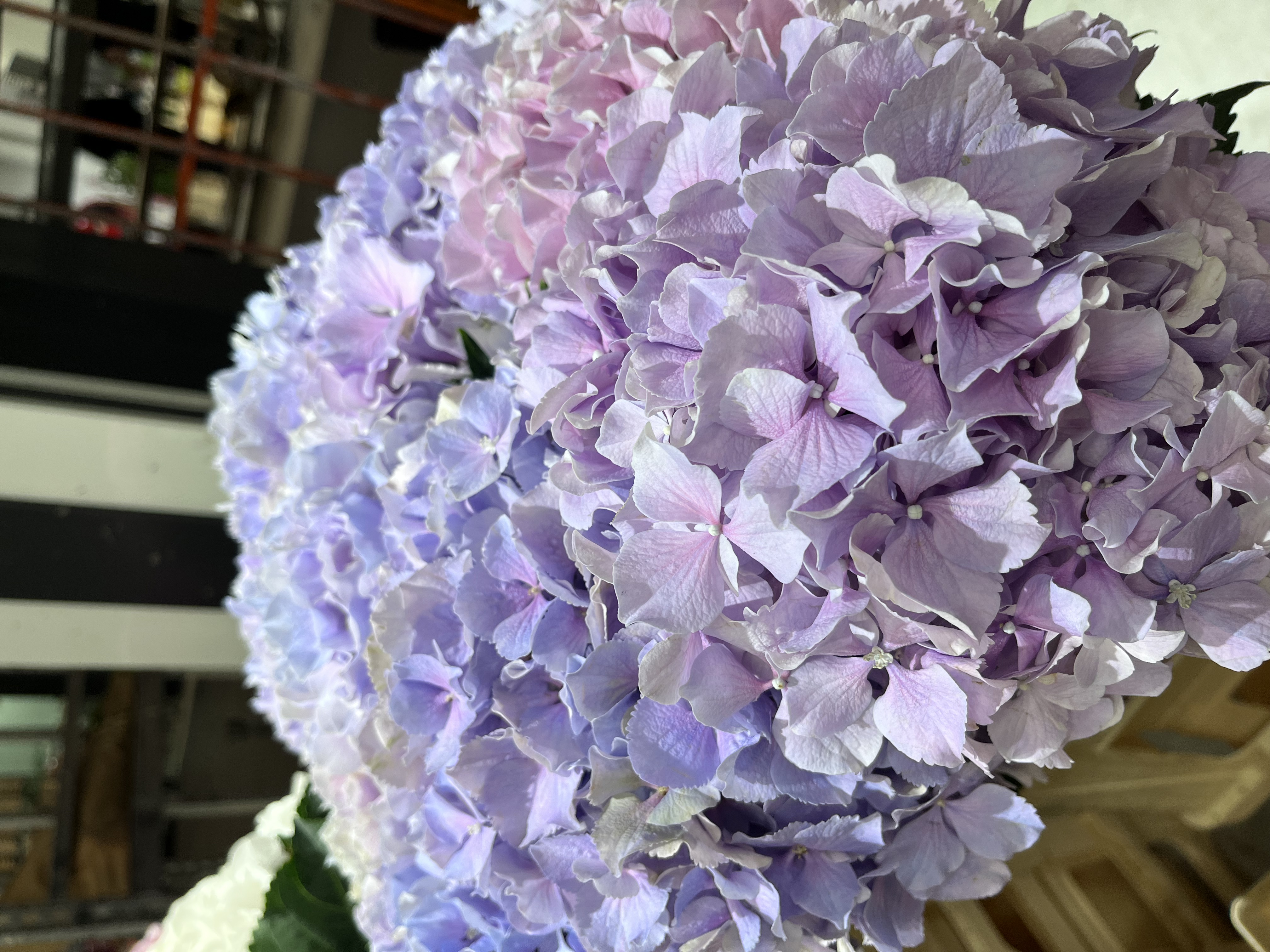
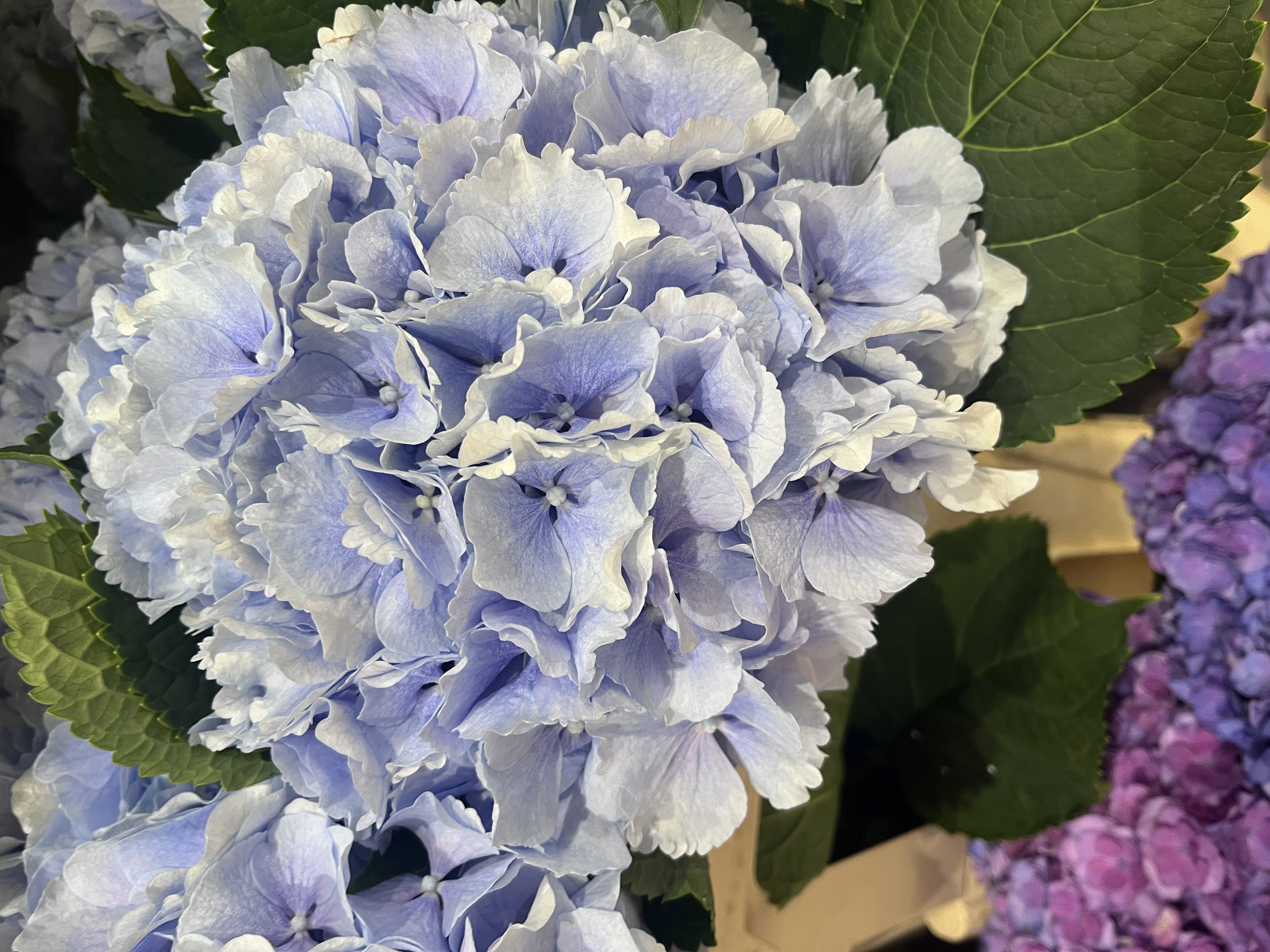
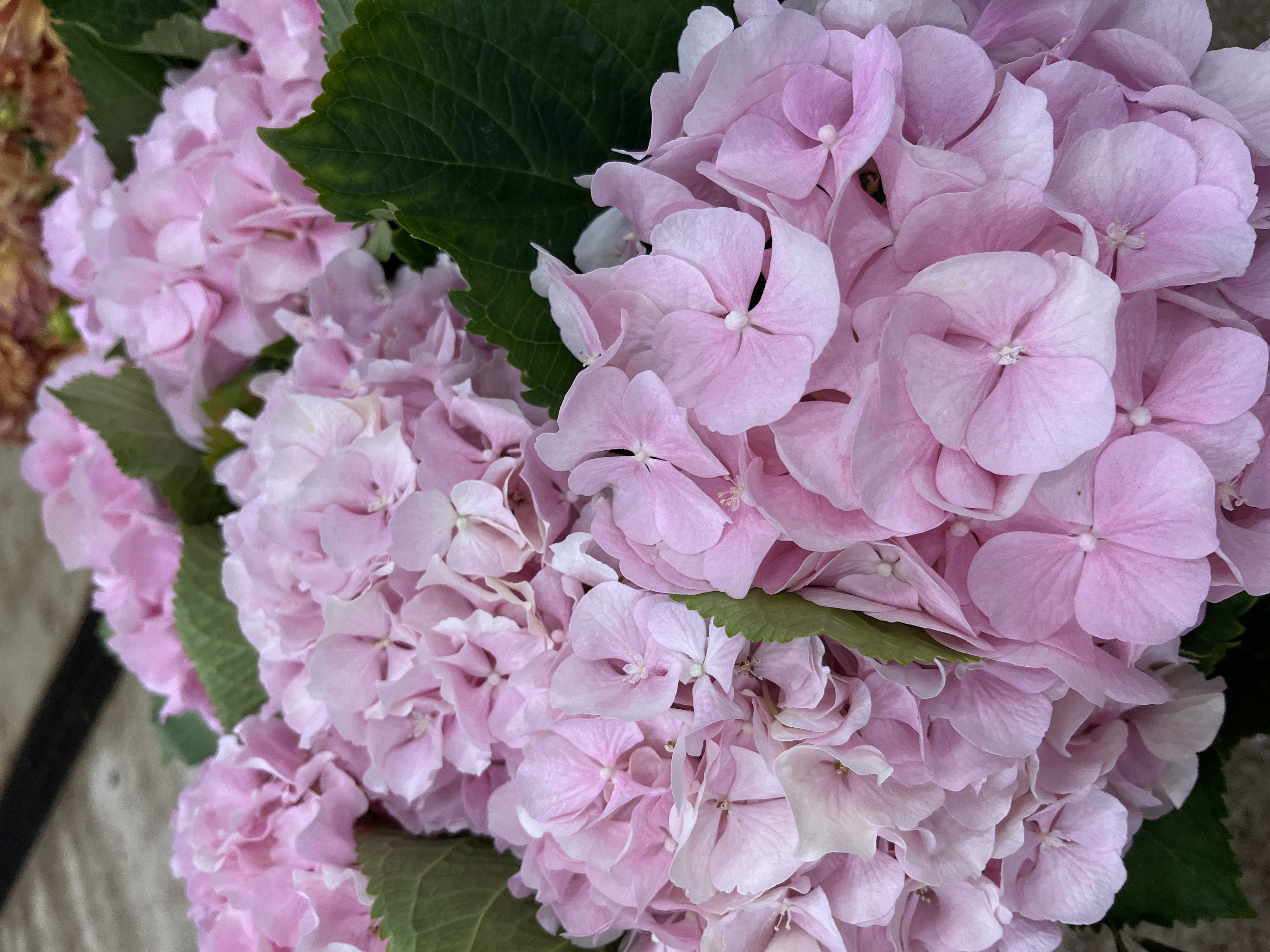
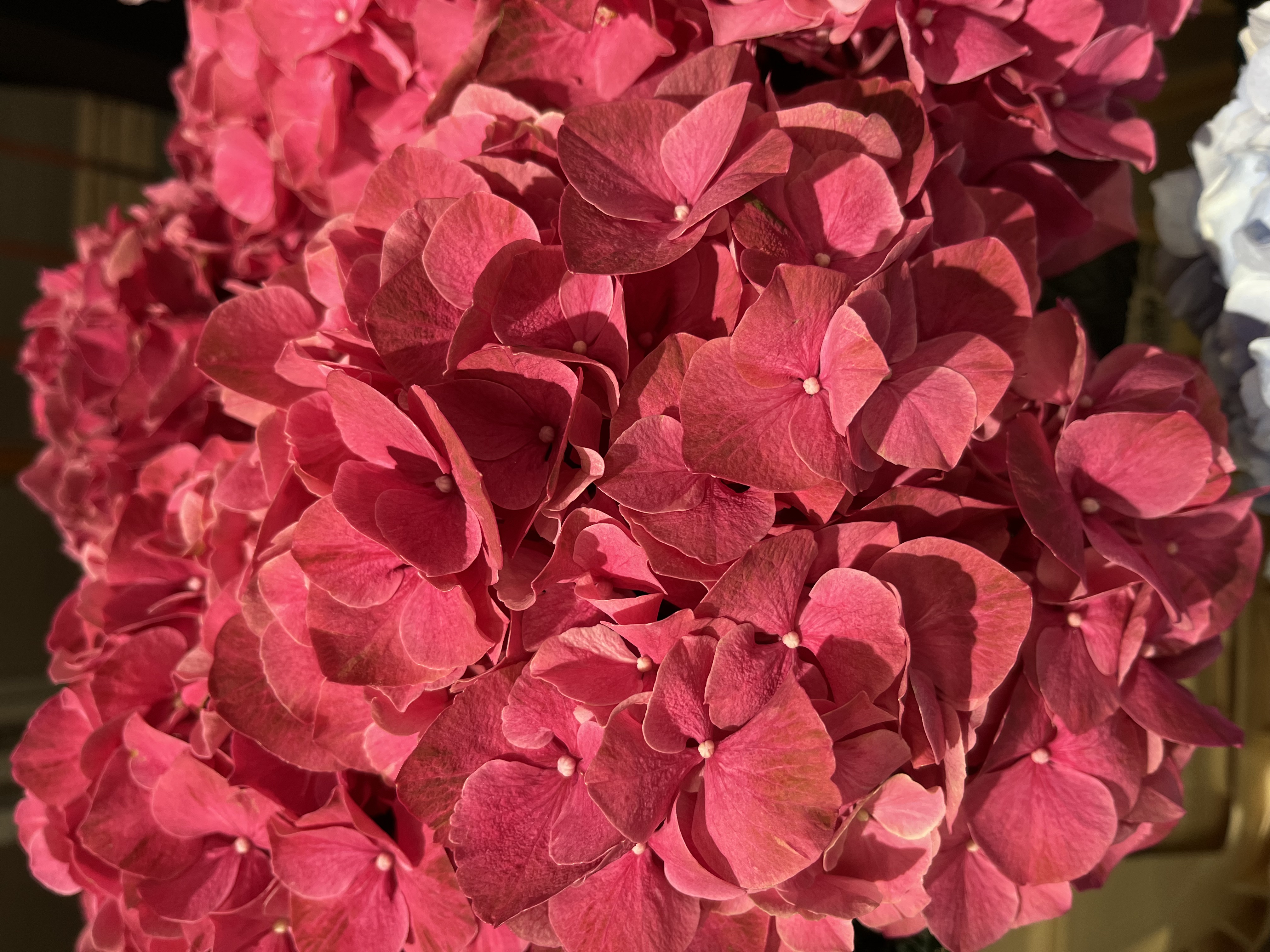
Late June to August — the large vivid heads. Royal Palace, Royal Parade, Royal Venice, Royal Love, Royal Benefit — the series from Royal van Zanten, a Dutch breeder. Rodeo Rouge, one of the most vivid pink-reds on the market. This is the peak of the season. Blues deepen, pinks intensify, deep wine and purple heads appear.
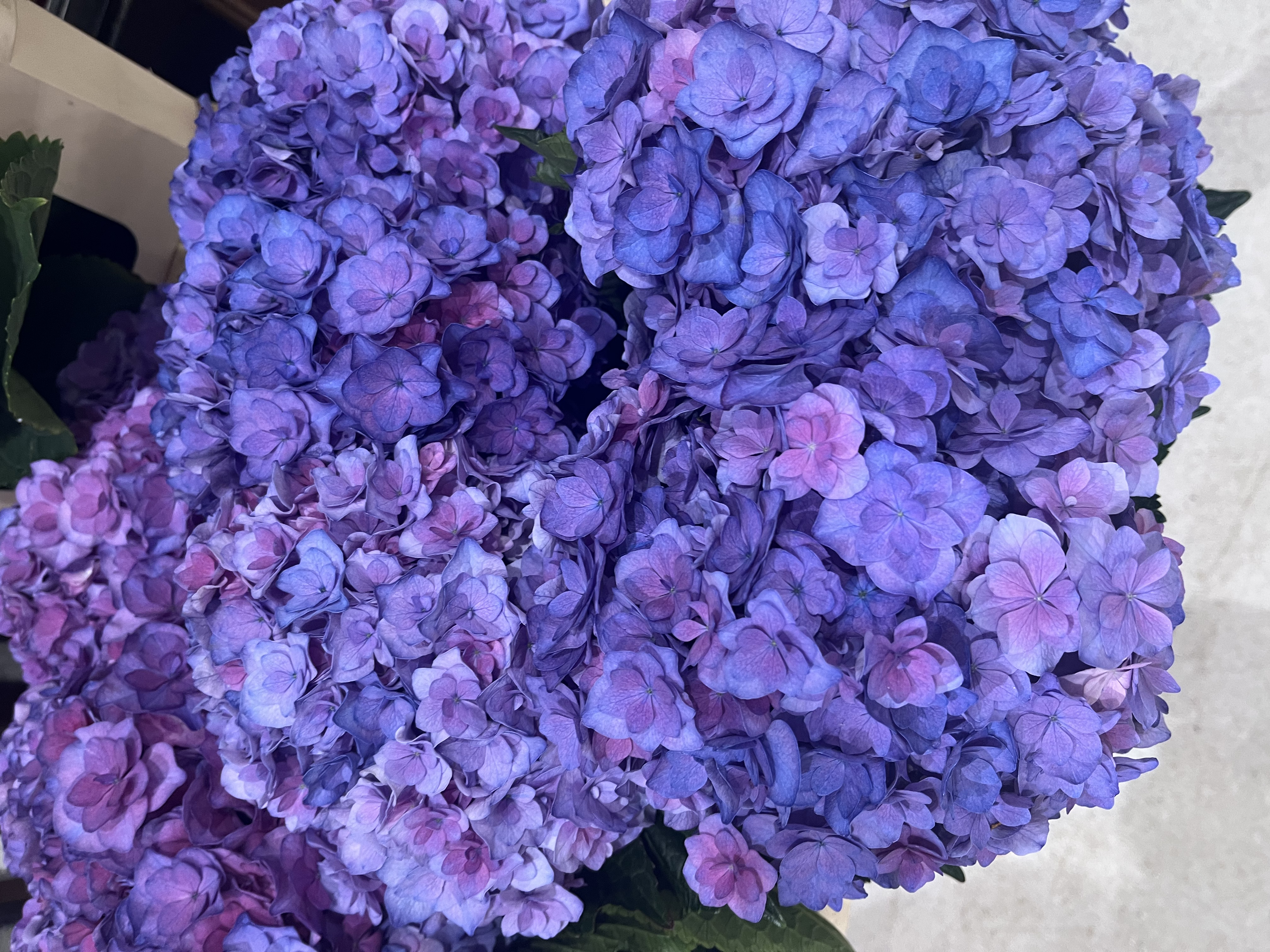
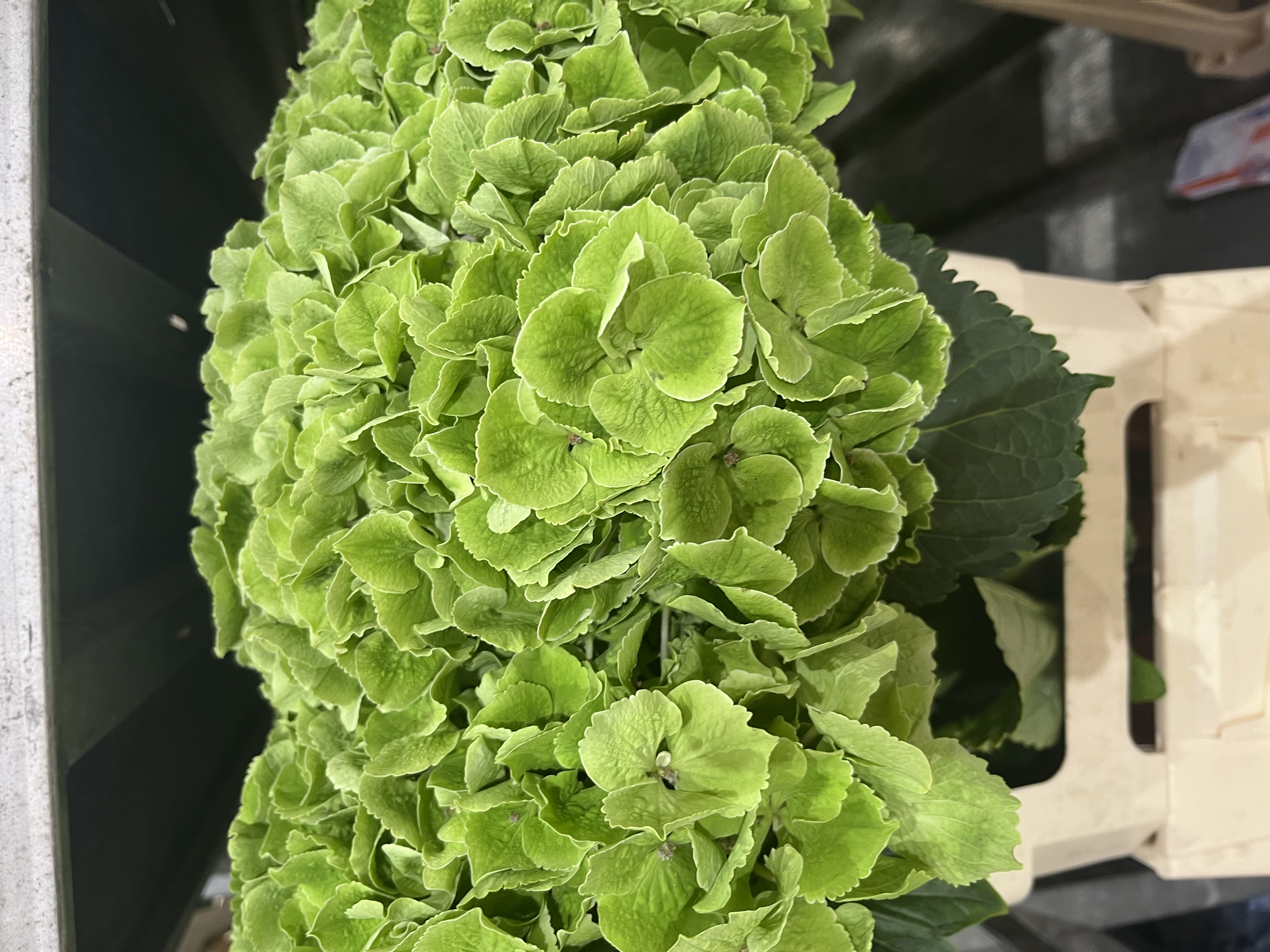
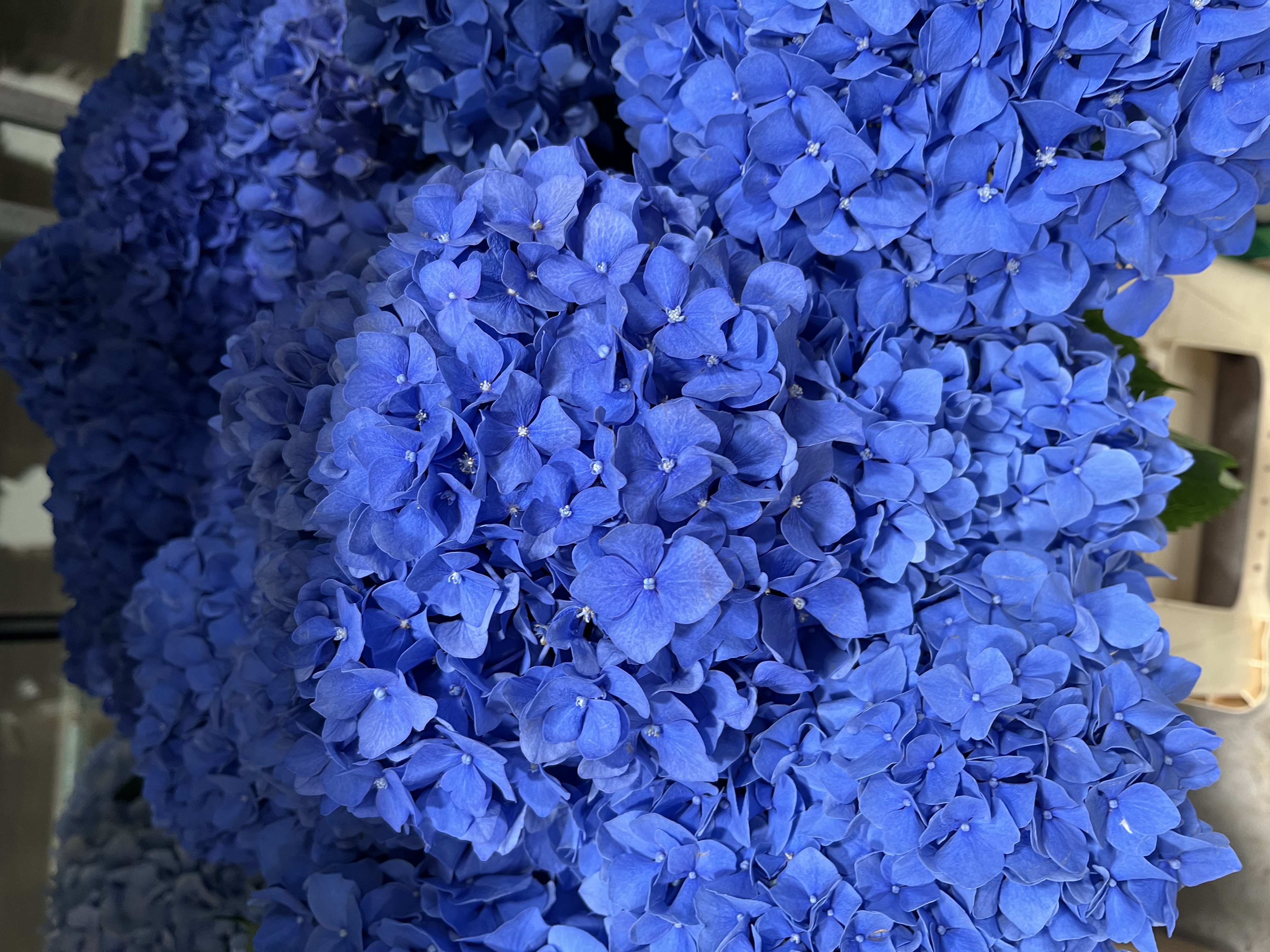
August through November — vintage cultivars and late-summer brights. The vintage category is recognised not by the word Classic in the name (which suppliers use inconsistently) but by the colour of the head: deep purple, burgundy, aubergine, antique green. On the market: Pernel Classic (deep purple flecked with green), Rodeo Classic Purple, Royal Palace Classic. Aubergine is a special case: a naturally deep aubergine pigment that gives a vintage impression to the eye, while the sepal is structurally closer to fresh. For a composition that plays this late-season green palette with a bold red accent, see our Bouquet Pulse of Paris.
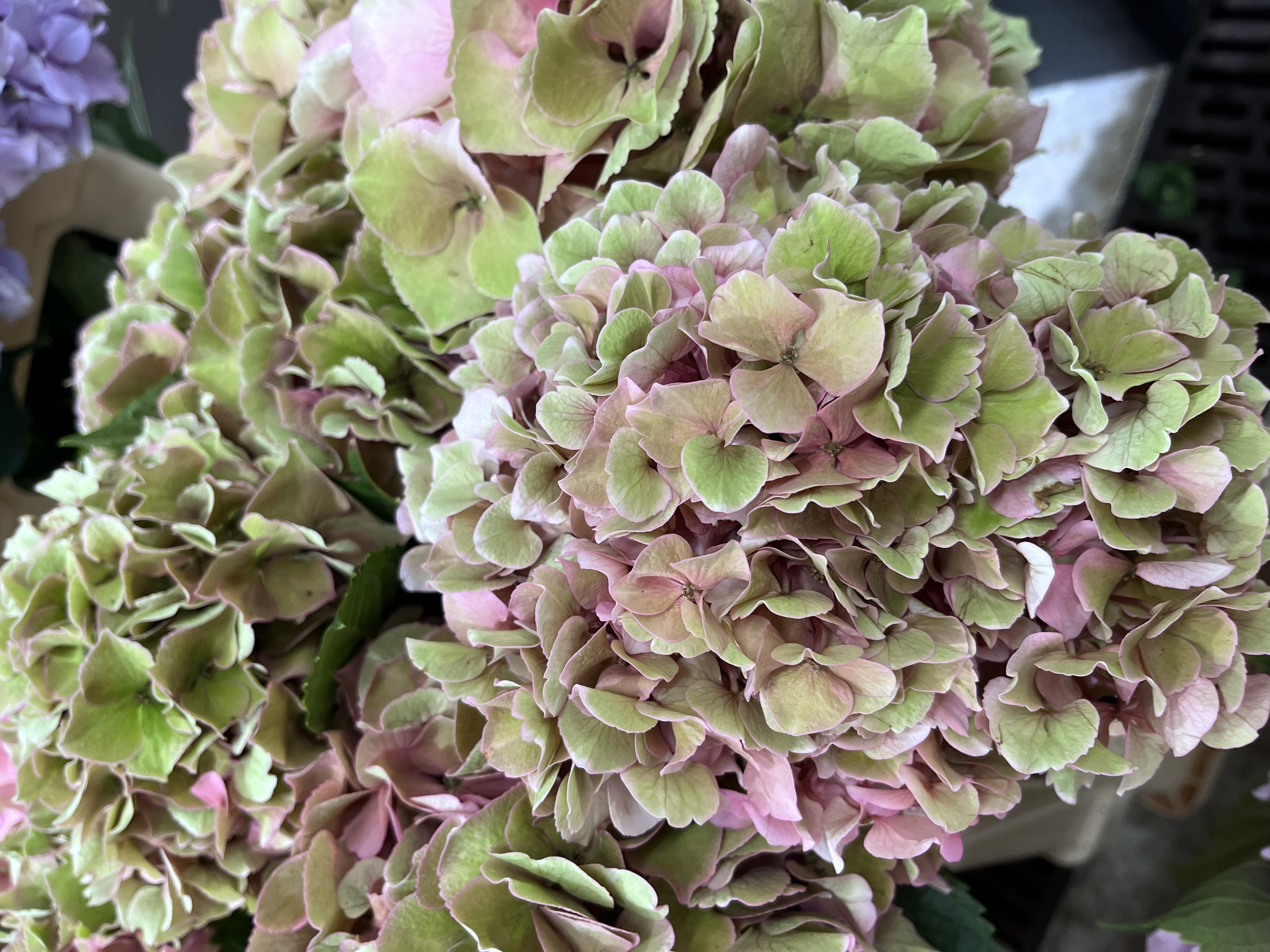
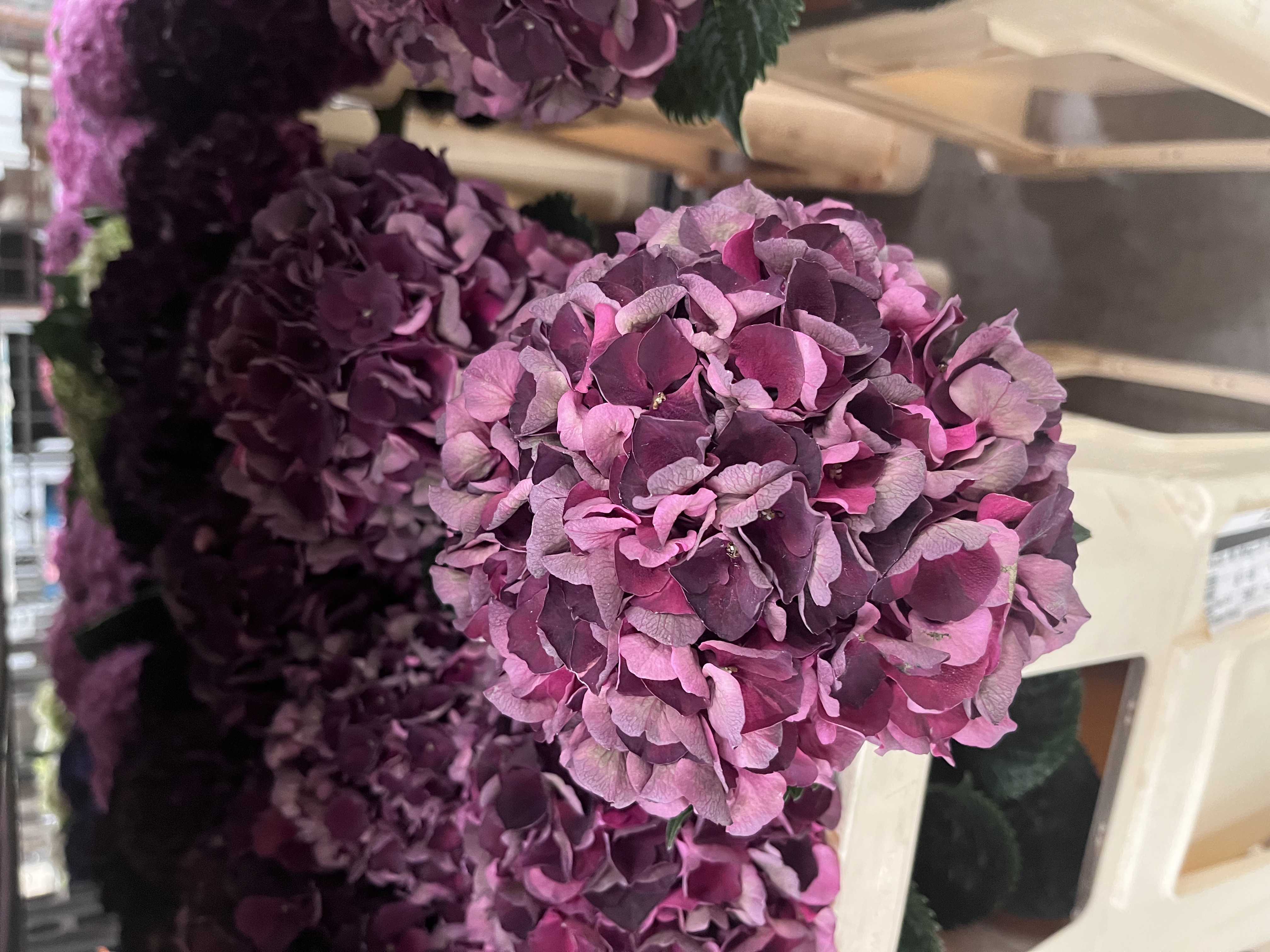
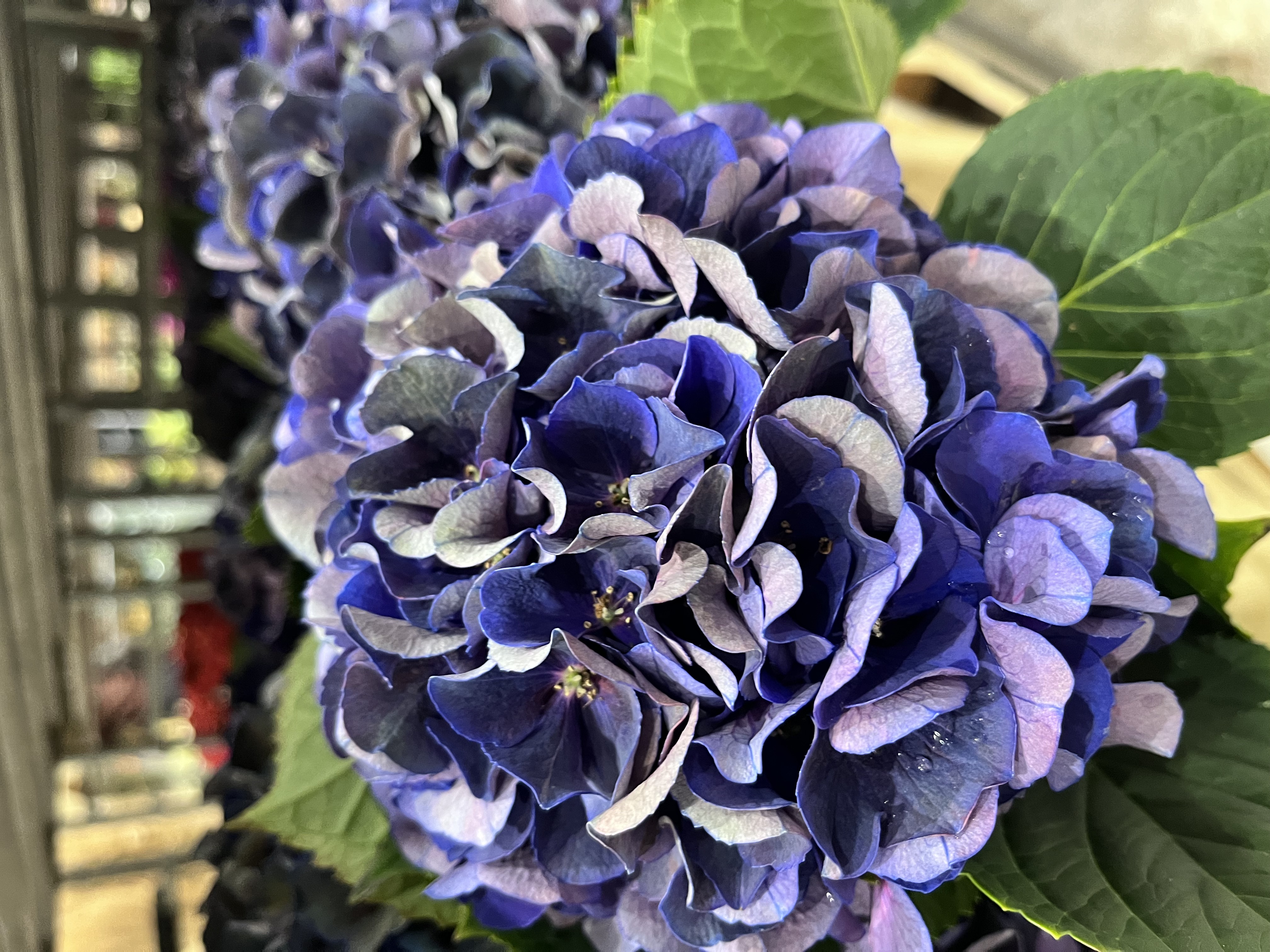
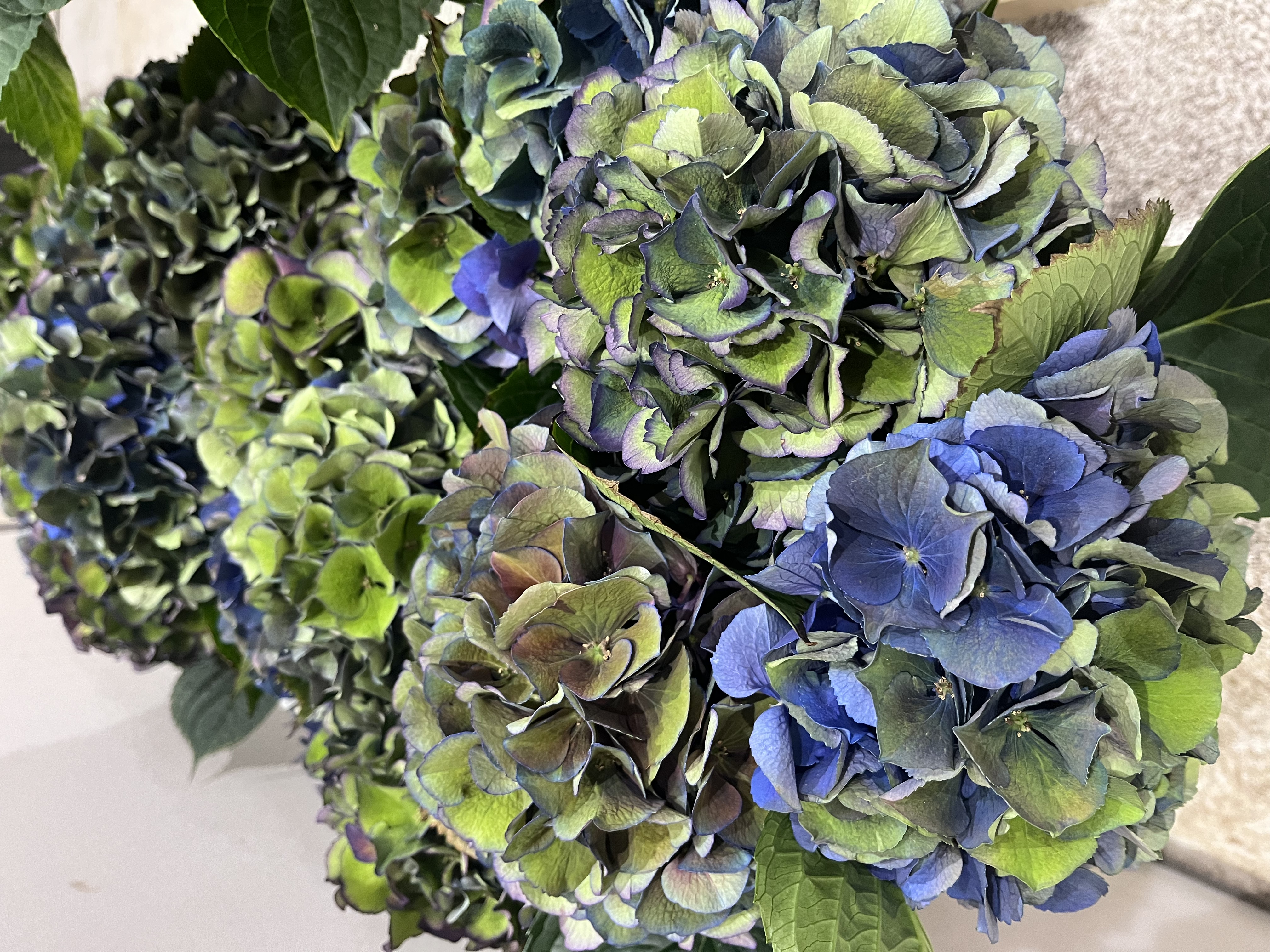
Alongside the vintages, fresh varieties continue to arrive in autumn in saturated late-season colours — Verena (without Classic), Verena Bleu, Verena Vert, Rodeo Light Classic, White Verena Classic. Despite varying suffixes, by colour they are light: pink, blue, white, soft multicoloured. Beautiful in a bouquet for a week, not for drying.
And one further material in this part of the season — Hydrangea paniculata Magical Candle. A different species, with conical inflorescences: white cones turning pink-wine at the end of the bloom. Dries perfectly; the small dense florets are naturally papery.
Where they come from. The main European hub for cut hydrangea is the Dutch auction system, FloraHolland in Aalsmeer. Even French growers from Anjou and Brittany (the two main French hydrangea regions) prefer to sell through the Dutch auction — volume, speed, and price stability. So a French hydrangea grown in Brittany usually returns to Paris via Holland and Rungis. In winter, when the European season is closed, the source becomes Colombia. Colombian hydrangeas are dense and consistent, but without the seasonal memory of a European bush.
Vintage hydrangeas — what they are and why they are stronger
A terminology note. "Antique" and "Classic" are not botanical terms; they are commercial designations used by suppliers. Dutch nurseries tend to use "Classic," French and English-speaking suppliers tend to say "antique". In the text I call them vintage.
When a customer sees a vintage hydrangea priced 30–50 % above Premium, the usual assumption is marketing. It is not marketing. It is a different material.
What physically happens during sepal maturation. In macrophylla left on the bush two or three months after the first flowering, the sepals undergo lignification. Cell walls thicken with lignin and cellulose — the same substances that build wood. The sepal goes from soft to paper-firm. In parallel the colour shifts: anthocyanin oxidises and darkens, chlorophyll reappears, and where there was once a uniform coloured field green patches emerge. The multicoloured effect that defines the category. Bred vintage varieties produce a similar result, but on purpose — without waiting on the bush.
The vintage hydrangea holds its shape for weeks instead of days; does not wilt in the conventional sense because its sepal structure is already nearly dry; offers a colour no fresh variety can match; and is the only cut flower that dries without losing form or much of its colour.
If you want a bouquet that lasts and ages well, choose vintage. If you need a fresh pastel for a one-day event, Premium.
How to arrange hydrangea
The main rule. Hydrangea is a garden flower. Mix it only with other garden flowers. Peony, garden rose, delphinium, sweet pea, ranunculus, branches of flowering shrubs — that is its language. Field flowers (cornflower, poppy, daisy) and hothouse exotics (anthurium, heliconia, protea) are a different floral planet: next to hydrangea they read as material from someone else's life.
Hydrangea likes solitude. The big head is its own scale. Adding small things dilutes the monolith.
The strongest move is a mono bouquet. Five to seven heads of a single colour (or a single vintage chord) in a wide low vase. No other flowers. No filler greens. Only hydrangea and the empty space around it. It works like a one-line poem — one head is already enough to hold a room. An example of this single-gesture move in navy blue: our Bouquet Blue Ocean Charm.
Alternative to mono: hydrangea with a single tall branch. Eucalyptus cinerea with its round silver leaf. An olive branch. Smilax. Spirea in spring, an ivy stem in late autumn. One vertical for five to seven horizontals, that is the geometry.
Good companions in mixed compositions: hydrangea with peonies in May–June (Sarah Bernhardt or Festiva Maxima, the dense double against the cloud-like hydrangea); with garden roses in the David Austin, Constance Spry, Juliet style; with dahlias in August (the dahlia's sharp form against the hydrangea's soft mass); vintages with dry branches, berries and seedheads in September–November; with freesia and sweet pea for fresh seasonal bunches in early summer. For this hydrangea-and-garden-rose chord, see our Bouquet Blue Radiance.
What to avoid. Not with standard Dutch commercial roses — the matte sepal clashes with the glossy petal. Not with tropicals. Not the "bouquet with everything in it." Hydrangea asks you to commit to it.
And do not mix fresh Premium with vintage Classic in one composition — physically different materials, the eye reads the mismatch.
How to make hydrangea last, and why it wilts
It is the most temperamental cut flower in my work. It can stand fresh in the morning and droop by evening. And come back in an hour, if you know what to do.
Why it wilts. Hydrangea literally means "vessel of water." Not marketing — biology. The huge head of sepals loses water to evaporation faster than the semi-woody stem can supply it. The stem has low hydraulic conductivity. Once the cut end dries out, it closes and stops drinking. The head dehydrates in an hour.
At purchase, choose a dense firm head. Thick toned sepals, no soft spots. Counter-intuitively, vintage hydrangeas with already partially toughened sepals last longer than the very freshest Premium.
Do not leave the stem too long. Counter-intuitively, in hydrangea this is the opposite of most cut flowers. The semi-woody stem has high hydraulic resistance: the longer the path, the more water is lost on the way, and the sepal mass evaporates a great deal. On a long stem the water simply does not arrive in time. Professional florists often shorten hydrangea to 15–25 cm from the head.
A clean slanted cut, 2–3 cm from the base. Knife or secateurs, never household scissors. A crushed stem does not drink.
Split the cut vertically by 1–2 cm. Increases the surface area for water uptake. A classic florist trick for all woody stems.
Strip every leaf below the waterline. They rot first and contaminate the water.
A tall vase with plenty of water. The stem should be submerged as deeply as possible — almost to the head if the vase allows. Hydrangea drinks a lot. And a large volume of water guarantees the cut stays submerged even as the level drops; an exposed cut embolises in seconds and stops drawing. For the right vase choice, see also which vase to choose.
Cold water. Not lukewarm. Fresh from the tap.
A cool room. Not in the sun, not near a radiator, not next to fruit (the ethylene from apples and pears accelerates ageing).
Change the water every day and refresh the cut by two centimetres each time.
In the morning, mist the head with a spray bottle. The sepals can absorb water directly through their surface — a unique feature of hydrangea among cut flowers. Misting offsets the evaporation losses by bypassing the stem.
Reviving a drooping hydrangea. If the head falls, do not throw it out. Three-step professional technique.
One, wrap the head in thick paper (newspaper, kraft, plain white paper folded into a loose cone around the head). The paper creates a humid microclimate around the sepals and stops the surface evaporation. Without this step, any water the stem manages to draw up will evaporate back into the air immediately.
Two, recut the stem by 5 cm with a clean sharp cut. To remove the section clogged by bacterial biofilm and embolism, and expose clean xylem. Less than five centimetres is not enough — the blocked section is longer than it looks.
Three, literally submerge the hydrangea in water. A tall vase or a basin of very cold water; the stem should be immersed as deeply as possible, almost up to the head. While the paper holds the humidity around the sepals, the stem slowly draws water through the fresh cut and refills the head from inside.
After 30–40 minutes, take the paper off and check: if the head is back, return it to a normal vase. If it is still drooping, leave it another 30 minutes. The method works in most cases except the very far gone.
For a complete guide on keeping any cut bouquet alive, see The bouquet that lasts.
How to dry hydrangea, and which ones dry
One of the main upsides of the vintage stage — it dries and stays beautiful for months, sometimes years.
Why vintage. In light hydrangeas, the sepals are soft and full of water. Dried, they lose volume, curl, look like crumpled paper. In vintages, the sepals are already partly lignified on the bush — almost paper, with little water inside. Dried, they barely change shape.
Which dry reliably. Simple visual rule: only dark and green hydrangeas dry. Wine, burgundy, aubergine, purple, antique-green with burgundy patches. These are the colours a sepal takes on after the anthocyanins oxidise and chlorophyll returns — that is, after physical lignification. From what is usually on the market: Pernel Classic (dark purple with green), Rodeo Classic Purple (deep purple), Royal Palace Classic (large dark heads). And separately, Hydrangea paniculata Magical Candle and Limelight: panicles at the mature stage, small dense florets naturally papery.
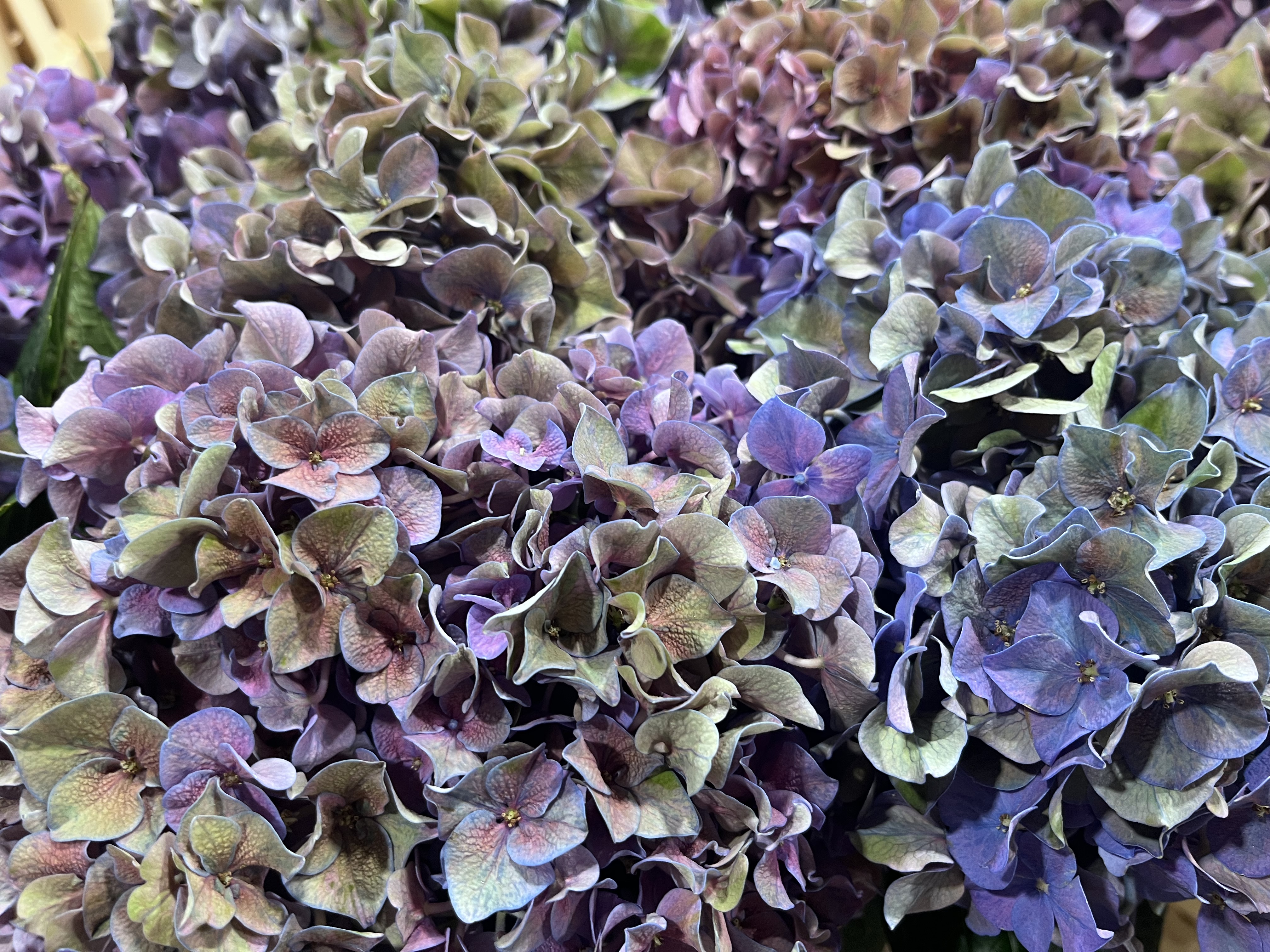
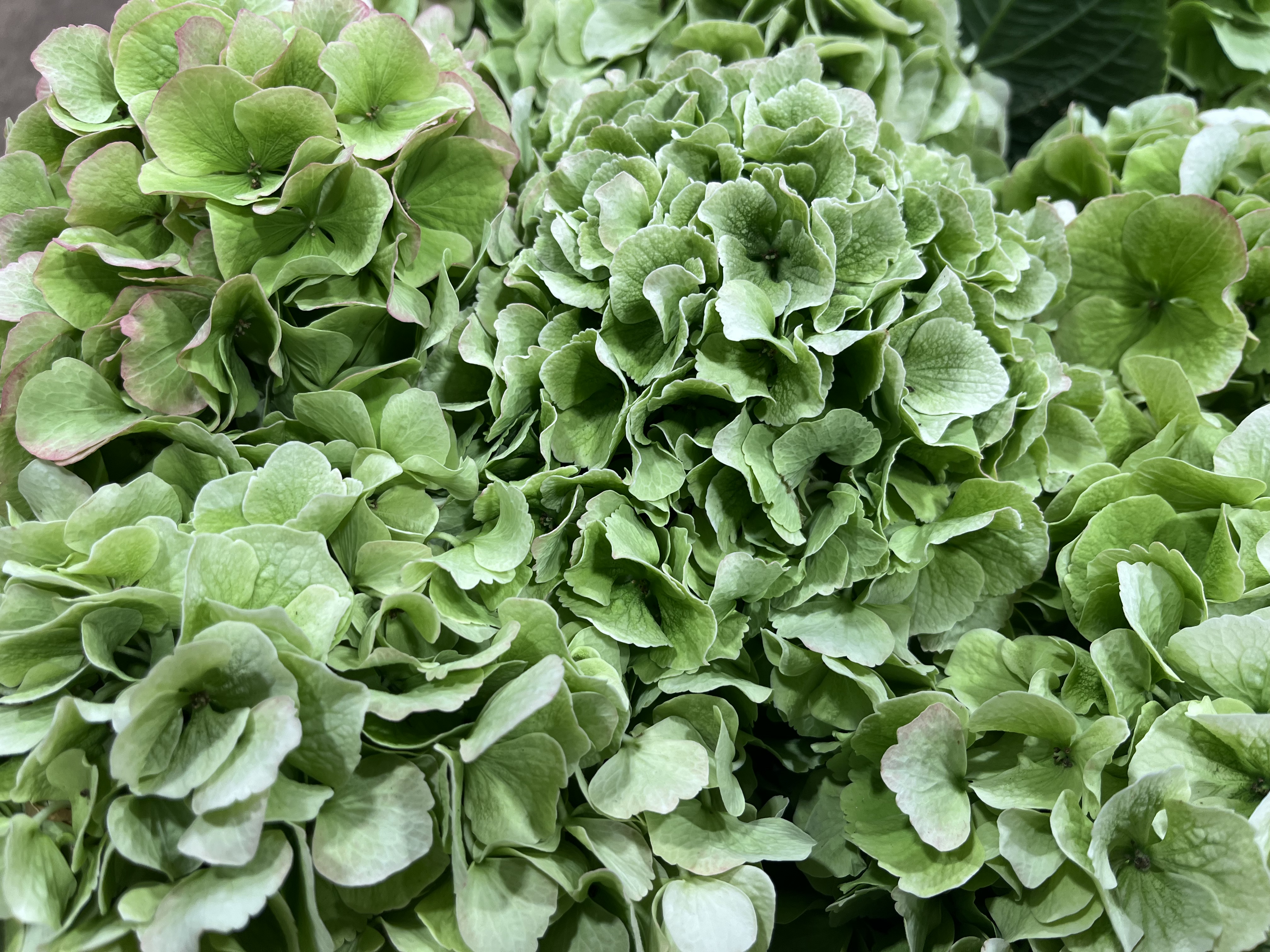
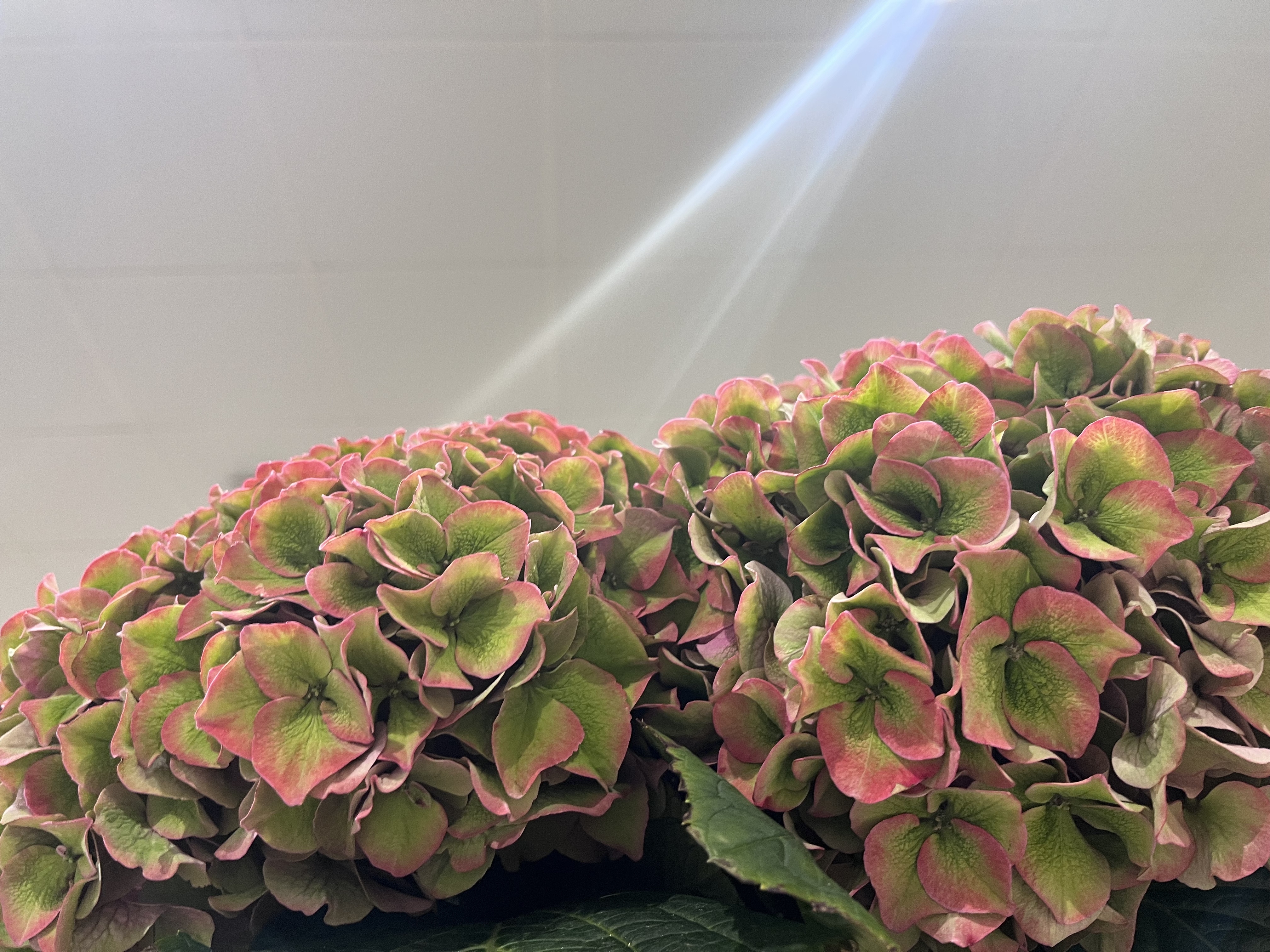
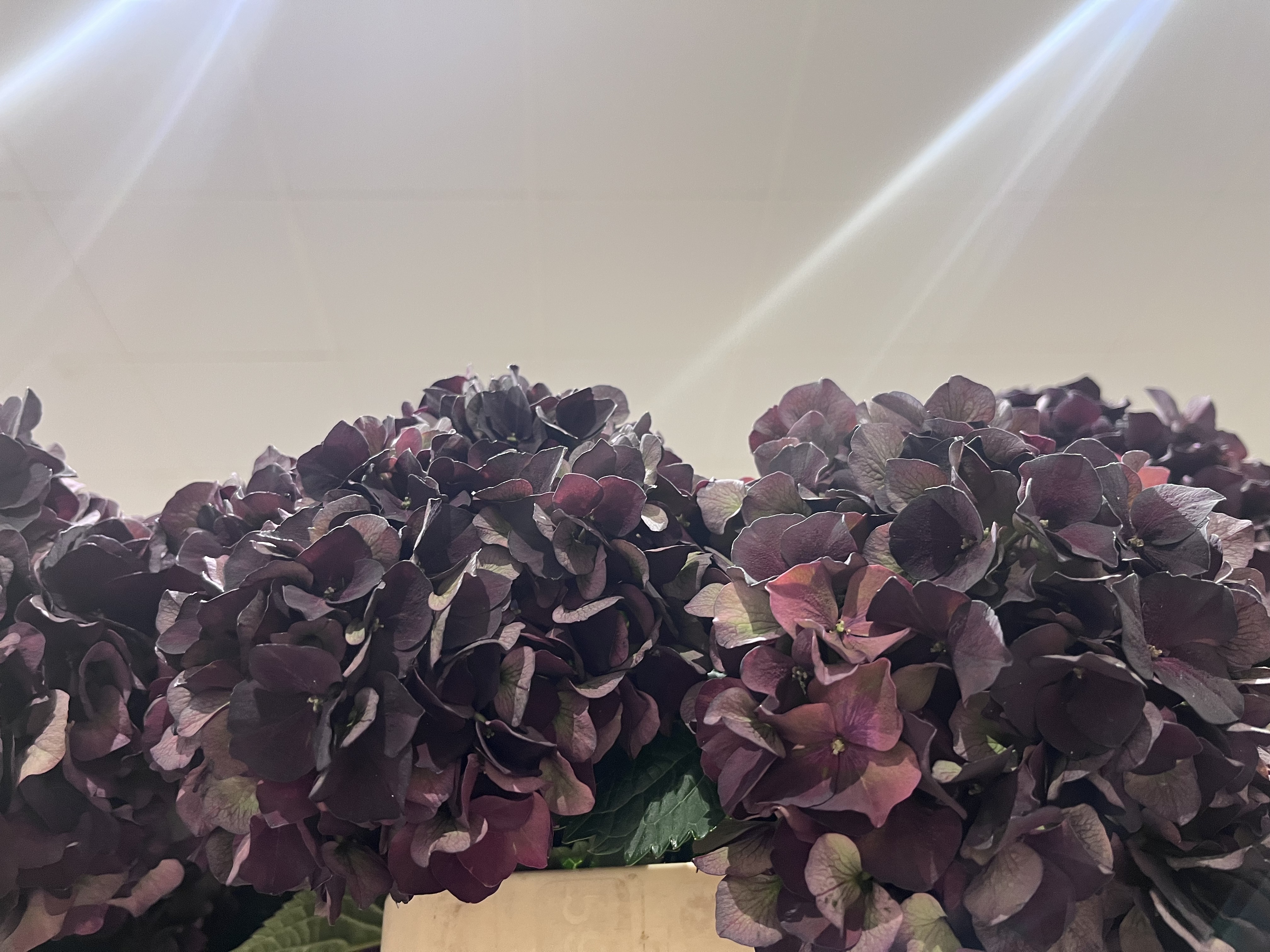
What does not dry. Every light colour — soft pink, blue, white, lavender, pale cream. The marker of the fresh stage: soft sepals, full of water, not lignified. When you try to dry them, the heads wilt and contract, losing both shape and colour. All Premium varieties (Premium Blanc, Bleu, Blush, Rose, Vert), Verena without Classic, Verena Bleu, Verena Vert, Schneeball, Royal Benefit, Royal Parade. Rodeo Light Classic and White Verena Classic, despite the Classic in the name, do not dry either — they are physically light.
Aubergine is a borderline case. Deep colour, but structurally often fresh. Dries unevenly.
How to dry. Two methods.
The slow way (best result). Cut the stems, strip the leaves. Put them in a vase with 5–7 cm of water. Do not top up. Let the water evaporate gradually over two to three weeks. The hydrangea dries inside its own bouquet, keeping form and colour. Soft, natural, no creases.
The fast way. Hang upside down in a dark dry place for two to three weeks. Dark because light bleaches the anthocyanins; dry because humidity invites mould. Faster, but slightly duller colour.
Do not dry in the sun or near a radiator. The colour burns off in days, the shape collapses.
Once dry, you can fix with hair spray to keep them longer. Store away from direct sun, otherwise the anthocyanins keep degrading and go beige within six months.
Hydrangea in history, art and Japanese festivals
The earliest written traces of hydrangea are Japanese. In the Manyoshu (万葉集), the anthology of Japanese poetry compiled around 759, two verses mention ajisai — hydrangea. Authors: Tachibana no Moroe and Otomo no Yakamochi. As a cultural object the hydrangea has existed in Japan for at least thirteen centuries. The bush grew at temples, the flower belonged to an aesthetic of change and patient flowering under rain.
Western science came to hydrangea later, and by a roundabout path. It was first described from North America — the American colonies were more accessible to Europeans than closed Japan. The British naturalist Mark Catesby in Natural History of Carolina, Florida and the Bahama Islands (1731) described the American species Hydrangea arborescens. The Dutch botanist Gronovius applied the Latin name Hydrangea to this American plant around 1739, and Carl Linnaeus formalised it in Species Plantarum (1753). So the word "hydrangea" as a botanical genus was born from American material, not Japanese.
The contact with Japan happened almost in parallel, but through a very narrow opening. The German physician Engelbert Kaempfer lived in Japan in 1690–92 at the Dutch trading post on Dejima — no other Europeans were allowed in. In Amoenitatum Exoticarum (1712) Kaempfer described the Japanese hydrangea for the first time in Europe, even before the genus had its name. The full scientific description of Hydrangea macrophylla appeared in 1784 in Flora Japonica, by the Swedish botanist Carl Peter Thunberg, a student of Linnaeus.
And finally, the story without which European hydrangea of the nineteenth century would be incomplete. In the 1820s the German physician and botanist Philipp Franz von Siebold was working in Japan — it is he who brought to Europe the main stock of Japanese hydrangeas on which the nineteenth-century European breeding was built. Siebold had a Japanese common-law wife, Kusumoto Taki, known as Otaki-san. He latinised her name as Otaksa and named a Japanese hydrangea variant after her — Hydrangea macrophylla var. Otaksa. Naming a plant after one's mistress was scandalous in Europe at the time, and there were attempts to strike the name from official nomenclature, but it stayed in the botanical literature of the nineteenth century. One of the best-known ornamental plants of Europe carries the Latin name of a Japanese woman who never came here.
In Japan, the hydrangea — ajisai — is the flower of rainy June, a symbol of the tsuyu and of long patient flowering. June is the month of hydrangea festivals — ajisai-matsuri.
Kamakura. The temple Meigetsu-in is literally called "hydrangea temple" (ajisai-dera) — about 2,500 bushes, peak bloom mid-to-late June. The neighbouring temple Hase-dera holds another large collection. Both sites are crowded in season.
Uji (Kyoto). The temple Mimuroto-ji with its ajisai-en garden — about ten thousand plants in fifty varieties. The garden opens specifically for the hydrangea season, from June to early July.
Tokyo. Bunkyō Ajisai Matsuri — a large urban hydrangea festival at Hakusan Shrine, held every year in mid-June since 1985, with about three thousand bushes.
And the unusual one — the Hakone Tozan mountain railway runs an ajisai-densha, the "hydrangea train," in late June along tracks lined with hydrangeas. A seasonal ritual: you ride slowly through the blue and violet mass, with rain falling outside the window.
In Japanese botanical painting, hydrangea is a recurring motif. Katsushika Hokusai in his cycle of flower prints around 1830 devoted a work to a hydrangea with a swallow — one of the most recognisable images of ajisai in art.
In Europe, hydrangea comes into fashion in the early nineteenth century. Joséphine de Beauharnais imports hydrangeas to Malmaison in the first decade of the century — part of her collection of exotic plants. By the 1820s, hydrangea is no longer a rarity in large French gardens.
Claude Monet at Giverny planted hydrangeas along the main path leading to the water lily pond — they are still there. Anyone walking the garden in July or August is mostly looking at hydrangeas in shades of blue and pink. Monet chose them for their ability to hold the long summer colour that appears in several of his late water scenes.
The main European destination for hydrangeas today is Le Jardin Shamrock in Varengeville-sur-Mer in Normandy. Founded in 1971 by Robert Mallet. The largest hydrangea collection in the world — more than 1,500 cultivars, officially designated a Conservatoire national. Flowering from June to October, peaking in August.
Where to see hydrangeas in France
Le Jardin Shamrock, Varengeville-sur-Mer, Normandy. The largest collection in the world, 1,500+ cultivars. Flowering June to October, peak August. The neighbouring Bois des Moutiers — historic early-twentieth-century garden with hydrangeas and rhododendrons — is worth the detour too.
Fondation Claude Monet at Giverny, Eure. Hydrangeas along the path to the water lily pond. Flowering July to September.
Parc Floral de Paris, in Vincennes. Hydrangeas in the collection. Métro Château de Vincennes.
Conservatoire botanique national de Brest, Brittany. Serious collection, including rare species. Brittany is one of the major French homes of the hydrangea — worth going for the flower in nature and in the nurseries themselves.
Anjou. The main French commercial region for cut hydrangea. Open days at the large growers in June through September.
Ordering a hydrangea bouquet in Paris
For home, a build-your-own bundle set with green hydrangeas and carnations: Nature's Whisper. And in blue — Electric Pulse (oxypetalum, hydrangea and delphinium bundles in kraft paper, to split across several vases).
I work with hydrangea year-round — from the softest Premium Blush to vintage Aubergine. Bouquet or armful built to order, around your colour, your interior, your season.
Delivery within Paris, every day except Sunday. The bouquet is built on the morning of delivery, after the market, and goes straight to your door.