
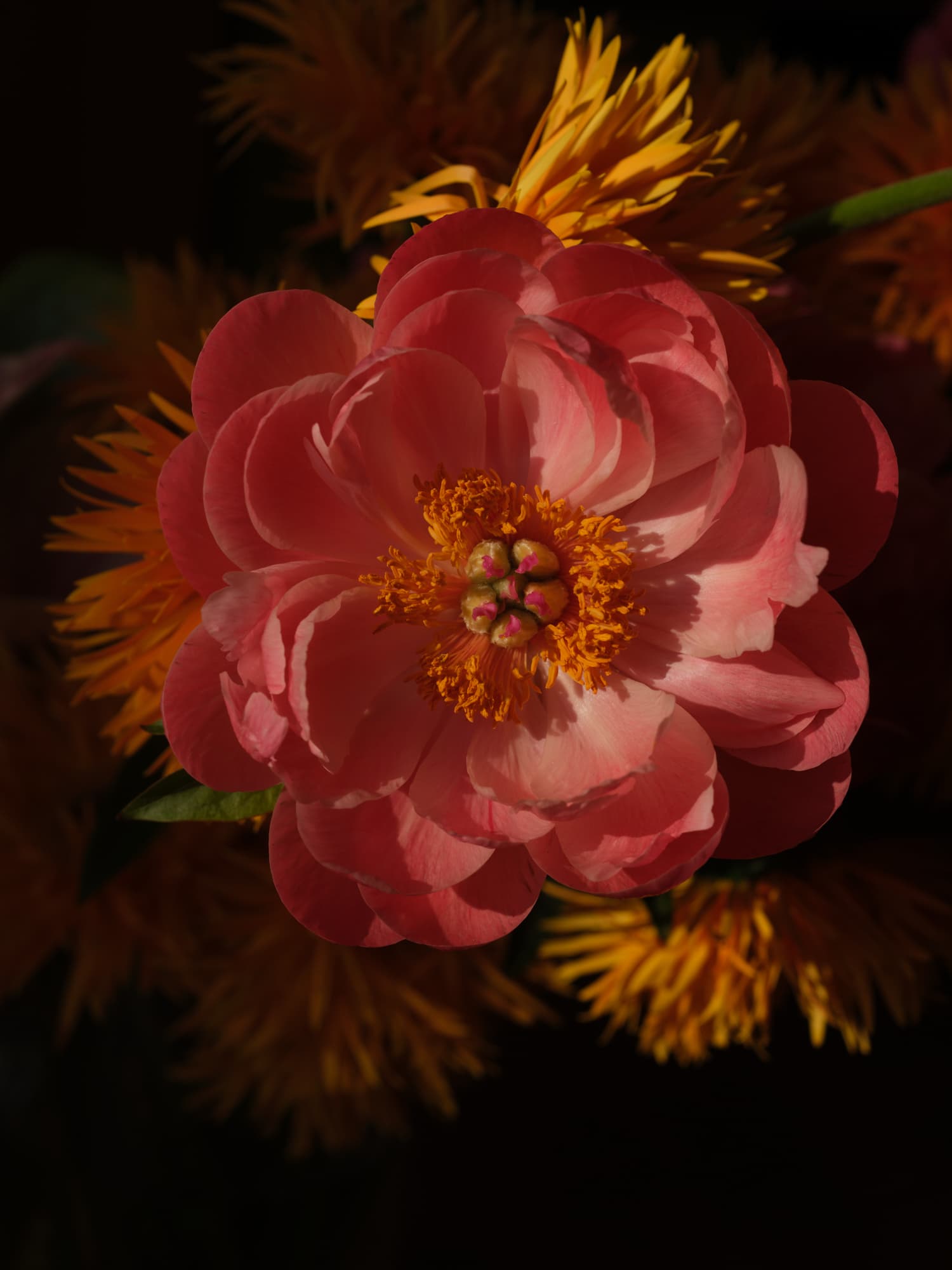
When peony season runs in Paris
The peony season in France opens in late April and closes through June. First to the market are the corals — Coral Charm and Coral Sunset, early, dense. Then the whites and the soft pinks: Bowl of Cream, Madame Claude Tain, Bridal Shower, Duchesse de Nemours. Then the heavy pink classics, Sarah Bernhardt, Reine Hortense, Mary Nicholls, Jules Elie — the round-headed bloom most people picture when they picture a peony. Alongside the June wave come the lemon and coral hybrids: Bartzella, Lemon Chiffon, Etched Salmon, Cytherea. By late June the market closes. What remains is Sarah Bernhardt and a few late intersectionals.
Exact dates shift year by year and supplier by supplier. Some import from Holland, others from Italy or the French south. One florist has corals on the shelf in mid-April, the next does not. In mid-May, the wholesale market already carries corals (Coral Charm, Coral Sunset, 40 to 70 cm), whites (Bowl of Cream, Madame Claude Tain), pinks (Sarah Bernhardt, Reine Hortense, Jules Elie, Mary Nicholls), burgundies (Red Charm, Old Faithful), the first yellow Itoh hybrids (Bartzella), and the early Cytherea, Angel Cheeks, Blush Princess. A single morning round at the market gives a palette for any mood.
Coral Charm and Coral Sunset — two corals, not one
These two get mistaken for each other most often. They shouldn't.
Coral Charm — three to four rows of petals, denser bud, deeper bowl shape. Colour at peak: saturated coral with a warm undertone, closer to salmon-pink. Petals firm, thick, slightly waxy. Bred by Samuel Wissing in the United States in 1964; American Peony Society Gold Medal in 1986.
Coral Sunset — two rows of petals, more open shape, like an upturned palm. Petals wider and larger than Charm's, but physically fewer. Colour at peak: brighter, more orange, closer to red coral. A Wissing seedling, commercially introduced by Klehm in 1981; APS Gold Medal in 2003.
Both are semi-doubles. Both open with a visible heart — yellow stamens inside a cup of petals, not a packed ball (a Wissing-series feature). Both carry a scent — and that surprises people holding a coral peony for the first time. The scent is not sweet, not perfumed: it is vegetal, slightly metallic, sometimes read as sharp. That is the cultivar signature, not a flaw.
What matters most: both shift colour over the life of the bunch. Coral Charm runs an arc — deep coral → peach → cream-ochre. Coral Sunset — bright coral with an orange note → soft peach → almost-yellow cream. One bunch passes through four colours in five days. That is the product, not the loss of it.
If forced to pick: Coral Charm holds form longer and starts darker. Coral Sunset is more dramatic at peak and more photogenic in the first two days. I often put both in the same bunch — they work as two registers of the same chord. For a bouquet of 100% Coral Charm, see Plunge.
Which peonies smell the strongest
The scent of a peony does not depend on its size or its colour. It depends on the cultivar. The most fragrant are the old French lactiflora hybrids from the nineteenth century.
Duchesse de Nemours smells of lemon peel cut with honey — recognisable from a metre away. Festiva Maxima: sweet, more classical, like an old garden rose. Sarah Bernhardt: soft, rose-honey, not intense but persistent. Bowl of Cream: sweet with a discreet vanilla note. Monsieur Jules Elie: spicy rose, dense, one of the most fragrant in the classical register (Crousse, 1888).
Less obvious: Edulis Superba, one of the oldest commercial varieties (1824), and Kelway's Glorious, with a spiced trail that reads as rose meeting clove.
What barely smells, or smells differently: the whole Wissing coral series — Coral Charm, Coral Sunset, Pink Hawaiian Coral — carries a vegetal, slightly metallic scent, sometimes harsh to untrained noses. Red Charm: almost nothing. Most Itoh hybrids (Bartzella, Cora Louise, Garden Treasure): barely perceptible. The price for the palette these hybrids bring.
Peony in perfumery is a separate story. The smell of peony in a bottle is almost always a reconstruction — peony's essential oil cannot be extracted (the molecule is too fragile). Perfumers build a peony accord from rose, lemon, violet leaf, and green notes.
The best-known peony fragrances: Jo Malone London Peony & Blush Suede (2013) — effectively the modern reference for what counts as peony in fragrance. Peony, red apple, suede.
Penhaligon's Peoneve (2013) — a denser London reading: peony, rose, violet.
Henry Jacques La Pivoine — niche ultra-luxury, peony with no scaffolding.
Christian Dior Miss Dior — peony anchors the formula alongside rose.
L'Occitane Pivoine Flora — the most honest mass-market interpretation.
To smell the real thing before choosing a bunch, the cleanest test is Sarah Bernhardt and Duchesse de Nemours side by side. Two different peony scents, both authentic.
The others worth knowing by name
Sarah Bernhardt — pink, classical, dense, full rose form. The bestselling peony in the world, still the leading commercial cultivar. If choosing one variety for one vase and stuck, this is it. (The story of the name — in the French culture section below.) For a large bouquet built around Sarah Bernhardt, see Hors-Mesure.
Monsieur Jules Elie — silvery pink, bomb-shaped, one of the most fragrant classical cultivars. Bred by Crousse in 1888; still in French wholesale catalogues under the name Jules Elie.
Duchesse de Nemours — white, crown-form, fine petals. One of the oldest in commercial culture — bred in France in 1856 by Calot. Lemon-honey scent, identifiable blind.
Festiva Maxima — white with bright pink flecks inside. Those flecks work as a freshness test: they should be crisp, not blurred. Bred in 1851 by Miellez. Older than most living plants in any garden.
Reine Hortense — pink, crown-form, medium density. A nineteenth-century French classic (Calot, 1857), named after Queen Hortense de Beauharnais, Napoleon's stepdaughter and the mother of Napoleon III.
Bowl of Cream — cream-white, large bud, golden stamens hidden in the centre. For people who want white without the boredom of white.
Etched Salmon — salmon petals with a waxy texture, an interspecific hybrid, sturdy. A piece of coral, only just released from the mould. For a bouquet built around Etched Salmon, see Tender Insolence.
Lemon Chiffon — lemon centre, white edge, bomb-shaped. Commercial window: about two weeks at the end of May. Outside it the market simply does not carry it.
Bartzella — lemon-yellow Itoh hybrid, a colour the standard herbaceous peony does not physically produce. New in Europe, expensive, but the only honest yellow peony.
Mary Nicholls — white with a faint cream-rose touch as it opens. Visually close to Festiva Maxima, but without the pink flecks inside — cleaner white. A discreet scent.
Florence Nicholls — soft pink that pales to a warm cream-white as it opens. The sister cultivar to Mary Nicholls, its chromatic opposite. One of the most delicate pink peonies on the market.
Gardenia — bright pink outer petals, ivory centre. Bred in the United States in 1955 by Lins. Fragrant, rose-form. A single Gardenia at the heart of an arrangement acts like a magnet — the eye stops there.
Dr. Alexander Fleming — deep fuchsia, with slightly lighter central petals. The Dutch commercial classic. Named after the Scottish bacteriologist who discovered penicillin (Nobel Prize 1945). One of the bestselling bright-pink peonies in Europe. Thick, firm stems — it holds for days.
Angel Cheeks — soft pink, bomb-form, with translucent cream inner petals. Registered by Klehm in 1973, sweet-scented. One of those peonies that reads as classical pink but with a less obvious shape than Sarah Bernhardt — taller, more cake-like.
Red Charm — deep burgundy, dense ball, serious, no scent.
Pink Hawaiian Coral — a third coral often grouped with Charm and Sunset. Bred by Klehm in 1981. Pinker than Charm, lighter than Sunset. Less common in cut flowers, worth catching when it appears.
Cytherea — an early hybrid in bright semi-double pink (Saunders, 1953). One of the first on the market, ahead of the classical lactifloras.
How to arrange peonies
A peony is already a composition. The bud is large, the shape declares itself, the colour holds the room — adding too much around it muffles it.
The strongest move: peonies alone, plus a few tall branches. This is how Manet and Fantin-Latour painted them — five to seven peonies in a wide vase, one or two long stems with leaves or blossom, nothing else. The result reads like a still life: tight format, one or two colours, the whole thing carried by the mass of buds. Branches that work this way: Spirea, Smilax, olive, eucalyptus (Cinerea with its round silver leaf), flowering fruit branches (cherry, apple) in April–May.
The second move: peonies with other garden flowers. The rule is one family. Everything should read as garden, nothing should read as plastic-glossy hothouse. The best pairings:
Hydrangea. Large on large, but contrasting texture: peony dense, hydrangea cloud-like. Particularly successful — pink peonies with blue or nuanced hydrangea.
Garden roses in the David Austin, Constance Spry, Juliet, Yves Piaget style. Peony-shape roses have a similar density and form. The bunch becomes lush, dense, slightly excessive — almost Fragonard-leaning.
Freesia and sweet pea. Scent is the only honest way to outbid a fragrant peony without confusing the picture. Freesia brings a lemon-pepper note, sweet pea a confectionary one.
Ranunculus, anemones. Only in early season, while they are still around. On the peony's scale, they do not disappear.
Lilac. May. Two or three days a year when lilac and peony overlap. Short window, but when it opens, you walk away with a bunch you remember.
Delphinium. For verticals and more painterly compositions, blue delphinium with coral peonies works like Hockney — clean blue and orange with no half-tones (Pool with Two Figures, 1972).
What to avoid. No tropical flowers (heliconia, anthurium, protea) with peonies — different languages. No standard Dutch supermarket roses — the peony looks washed out next to them. No bunch with everything in it. The peony demands a choice in its favour.
One more thing — peonies do not like crowded hands. The looser the arrangement, the better the buds open. In a tightly bound bouquet some buds may never open at all.
A few things only florists tend to know
In Greek mythology, the peony was linked to Paeon, physician of the gods, who treated the Olympians' wounds at Troy. According to Ovid, Asclepius grew jealous; Zeus turned Paeon into a flower to save him. The Latin paeonia comes from there.
The peony is among Europe's longest-lived perennials. A plant in a garden can flower for fifty, seventy, sometimes a hundred years on the same spot. Some French estates still hold peonies planted under Louis XV, still blooming every May.
Ants on the bud are neither pests nor allies. They eat the sweet nectar the peony secretes on the closed bud. The peony does not care. The old belief that a peony cannot open without ants is a myth.
The Itoh hybrid, or interspecific peony, crosses a herbaceous peony with a tree peony. The first successful cross was made by Japanese breeder Toichi Itoh in Japan in 1948. Itoh died in 1956; his widow passed several plants to the American Louis Smirnow, who registered the first Itoh cultivars in the 1970s and brought them to wider distribution. Today Itoh varieties — Bartzella, Cora Louise, Garden Treasure, Lollipop — keep gaining ground for the palette: lemon yellow, two-tones, colours the classical herbaceous peony does not carry.
Peonies in French culture
France and the peony go back further than most people think.
Joséphine de Beauharnais, Napoleon's first wife, kept one of the first major botanical gardens in Europe at Malmaison in the early nineteenth century — Chinese tree peonies, brought in by the maritime expeditions of the period, were among its plants. Pierre-Joseph Redouté, her in-house botanical illustrator and the author of the famous Roses, later produced a series of peony engravings; part of his work is held at the Bibliothèque nationale de France.
Édouard Manet, in 1864–1865, painted a series of peony still lifes; the best known is Vase de pivoines sur piédouche, at the Musée d'Orsay. They may be the most recognisable peonies in the history of painting.
Henri Fantin-Latour, in the 1870s and 1880s, painted dozens of peony still lifes; his works are held at the Musée d'Orsay and in major collections on both sides of the Atlantic. Renoir as well — several of his peony still lifes date from the late 1870s.
And Sarah Bernhardt — the actress lent her name to the peony Victor Lemoine registered in 1906. Bernhardt was a global star at the time; perfumes, novels, and ship cabins already carried her name. Lemoine added the flower — and the flower outlasted the rest of the list. The Sarah Bernhardt peony is still the bestselling peony in the world.
Where to see peonies near Paris
To see peonies in the ground, not just in a vase, a few options within a day's reach of Paris.
Parc de Bagatelle, bois de Boulogne — a historic collection, including old French varieties rarely found in flower shops. Flowering from the second half of May through mid-June. Métro Pont de Neuilly, then on foot or by bus.
Parc Floral de Paris, in Vincennes — a large botanical garden with peony beds flowering from mid-May. Métro Château de Vincennes, then on foot.
Pivoines Rivière, Crest, Drôme — a private peony nursery founded in 1849, still run by the same family. One of the oldest specialist nurseries in Europe. The garden opens to the public on selected May weekends. Not a Paris afternoon — a trip, but worth planning.
Saint-Jean-de-Beauregard — château with a park south of Paris. Its Fête des Plantes runs twice a year; the May edition brings together the best French nurseries, peony specialists included. Walk, talk to breeders, buy roots for your own garden.
How to make a bunch of peonies last at home
When a bunch of peonies lands in your hands, a few moves decide whether it lives three days or seven.
The cut stage matters most. A proper cut peony arrives at marshmallow stage — bud firm but already soft when gently pressed, like a marshmallow. Too hard, the bud may never open. Too open, it fades within two days. A good florist picks the stage; the rest is on you.
Opening speed depends on the cultivar. Not all peonies open at the same pace. Coral Charm, Coral Sunset, Red Charm, Angel Cheeks, Cytherea open fast — within a day or two of the marshmallow stage. For some the reason is the semi-double form (fewer petals to unfurl); for others, the hybrid lineage (early hybrids mature and open faster). Full doubles with many petals — Sarah Bernhardt, Festiva Maxima, Duchesse de Nemours, Bowl of Cream, Jules Elie, Mary Nicholls — open more slowly. The bud may stay closed for three to four days, growing in size, then unfurl gradually over several more days.
If a bud arrives already slightly swollen, that is not a bad sign. The opposite — it is the active stage at which the peony will reliably open and live its full cycle. Only two states are a problem: a hard green bud that did not have time to mature on the plant, or a fully blown flower about to drop its petals. Everything in between is a working zone.
To speed up opening — warm water and bright light. To slow it down — cold water, a cool room, or even a night in the fridge.
Recut on a slant, at least one and a half to two centimetres up from the bottom. Sharp knife or secateurs, never household scissors — a crushed stem does not drink.
Strip all leaves below the waterline. They rot first and contaminate the water.
Cold water. Not warm, not room temperature — properly cold. Peonies prefer cold. To delay opening (a wedding, a dinner, a shoot), keep the stems in the fridge, wrapped in damp paper, lying flat. Away from fruit — the ethylene released by apples and pears speeds ageing.
Change the water every two days. Refresh the cut by a centimetre each time. If a bunch starts to droop, do not throw it away. Recut immediately by three to four centimetres, plunge into very cold water nearly up to the leaves for half an hour. In half the cases the peony recovers fully. In the other half, partially — which is not bad either.
Ordering peonies in Paris
The season is short, and that is the point of it. A few months a year, flowers appear that you then wait for again. If a specific variety matters — Coral Charm, Sarah Bernhardt, Jules Elie, Bartzella — write ahead. At the Rungis wholesale market, those varieties are not on every stand on every morning; catching the right one needs at least fifteen hours of lead time.
Delivery within Paris, any day except Sunday. The bunch is built on the morning of delivery, straight after the market, and goes to your door. Free delivery from €100. For a modern bridal bouquet around Coral Charm, see Hors-Script.